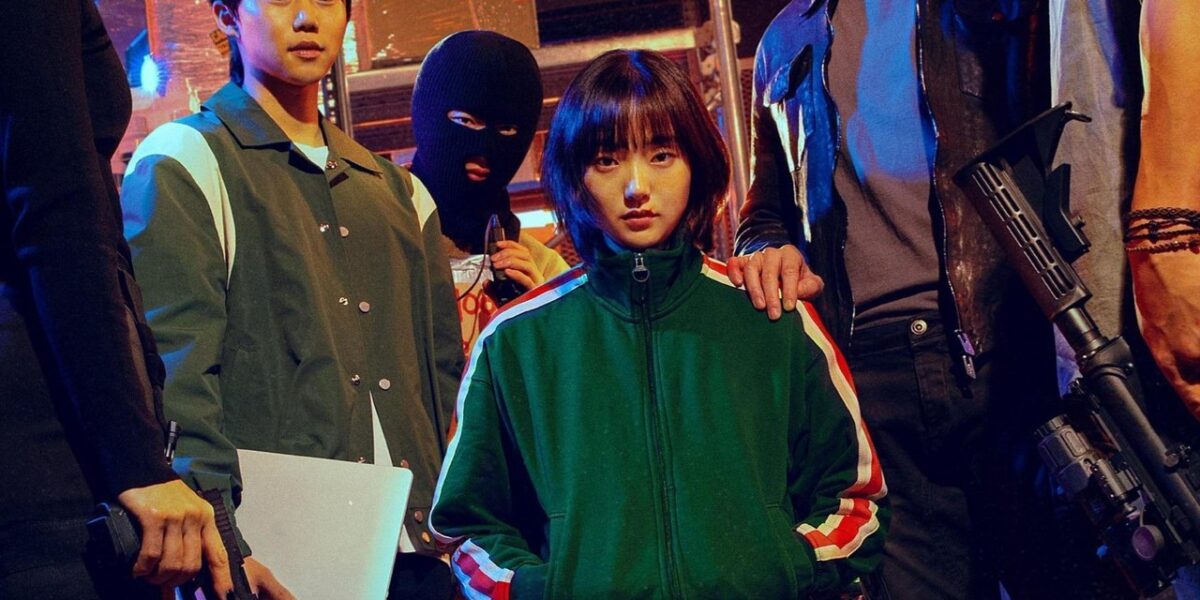
A Shop for Killers: Ending Explained — Ultimate Breakdown
A Shop for Killers arrives like a perfectly wrapped package concealing something dangerous inside — and its ending delivers on every dark promise the series makes from its very first frame. Created by E.oni and Lee Kwon, this South Korean thriller uses the death of an uncle as a detonator, blasting open questions about identity, inheritance, and the violence we unknowingly carry in our blood. What does the finale truly reveal? Let’s pull back the curtain.
A Shop for Killers: What happens at the end
The finale of A Shop for Killers converges on Jeong Ji-an, the niece who has spent the entire series surviving waves of professional assassins while uncovering the true nature of her uncle Jeong Jin-man‘s shopping mall operation. What appeared to be a modest e-commerce business is revealed as an elaborate front — a global weapons marketplace catering exclusively to the world’s deadliest contractors. Jin-man’s sudden death was not random; it was a calculated move to pass his empire — and its enemies — directly to Ji-an.
In the climactic sequence, Ji-an is forced to activate the very system her uncle built, using the hidden infrastructure he spent years preparing her for — without her knowledge. The final revelation is devastating in its elegance: every survival skill Ji-an believed she learned naturally was deliberately taught by Jin-man, who anticipated this exact confrontation. She doesn’t just survive — she inherits. The ending leaves her standing at the threshold of an underworld she never chose but is now inescapably equipped to navigate, operator credentials in hand.
The deeper meaning
At its symbolic core, the shopping mall is one of the series’ most precise metaphors — a place where violence is commodified, packaged, and delivered with the clinical efficiency of next-day shipping. The finale forces us to recognize that Ji-an‘s inheritance is not merely property or power; it is moral complicity. She inherits a machinery of death she didn’t build, mirroring real-world questions about generational legacy — how much of what we receive from family is gift, and how much is burden disguised as love.
E.oni and Lee Kwon‘s directorial intention appears rooted in a deeply Korean cultural tension: the Confucian obligation to family versus individual moral autonomy. Jin-man‘s love for Ji-an is genuine and monstrous simultaneously — he protected her by transforming her into a weapon without consent. The ending refuses easy catharsis. Ji-an is safe, but she is no longer innocent. The directors seem to argue that survival and purity are mutually exclusive in a world built on concealed violence.
Hidden details & easter eggs
Sharp-eyed viewers will notice that the shopping mall’s product categories — displayed briefly on screen throughout the series — correspond directly to the assassination methods used against Ji-an in each episode. This is not accidental production design; it is a layered piece of foreshadowing embedded in the visual language of the show. Additionally, Jin-man‘s final recorded message to Ji-an uses commercial shopping language — “thank you for your purchase” — recasting their entire familial relationship as a transaction, and a prepared one at that. The horror is in the warmth of his delivery.
Connections to the rest of the film
The series plants its most important seeds early. Jin-man‘s insistence on teaching Ji-an seemingly random skills — lock-picking framed as a game, physical endurance disguised as hiking — reads differently in retrospect. This sustained foreshadowing elevates the rewatch value considerably. The recurring motif of packages being delivered throughout the narrative gains sinister weight: every delivery shown is a quiet reminder that this world runs on logistics, and Ji-an has always been the most important shipment of all — a human asset, carefully packaged and timed for release. You can explore more about the series on IMDB.
Fan theories
One compelling theory holds that Jin-man faked his death deliberately to force Ji-an into activating her potential — evidence includes his suspiciously well-prepared farewell systems and the almost theatrical timing of the assassin attacks. Against this: his death is depicted with physical, unglamorous specificity that the show rarely fabricates. A second theory suggests Ji-an was herself a sleeper operative placed in Jin-man’s care by a rival faction, which would reframe her entire childhood as infiltration — a reading supported by certain ambiguous early flashbacks that the series never fully resolves.
FAQ
Does Ji-an take over the shop at the end of A Shop for Killers?
Ji-an gains access to the mall’s operational systems in the finale, effectively inheriting control. Whether she actively continues the business or dismantles it is deliberately left ambiguous, functioning as the series’ central moral cliffhanger.
Did Jin-man really love Ji-an, or was she always just an asset?
The series argues both are true simultaneously. Jin-man‘s affection appears genuine, but his actions — training her covertly, building systems around her — reveal a love expressed entirely through instrumentalization, which the show treats as its most unsettling theme.
Who were the assassins targeting Ji-an, and why?
The attackers represent rival factions and former clients of the mall who want either the platform’s access codes or its elimination. Ji-an is targeted because, as sole heir, she holds the only keys to the entire operation’s continuation or shutdown.
What does the shopping mall symbolize in the series?
The mall is a metaphor for the sanitized packaging of moral corruption — violence made transactional and anonymous. It reflects how institutions can normalize darkness through the language of commerce, convenience, and ordinary daily life.
Will there be a second season continuing Ji-an’s story?
The series is listed with 2 seasons, suggesting the narrative continues beyond the first season’s finale. Ji-an‘s ambiguous new role as inheritor of the killer marketplace provides fertile, unresolved ground for the story to expand meaningfully.