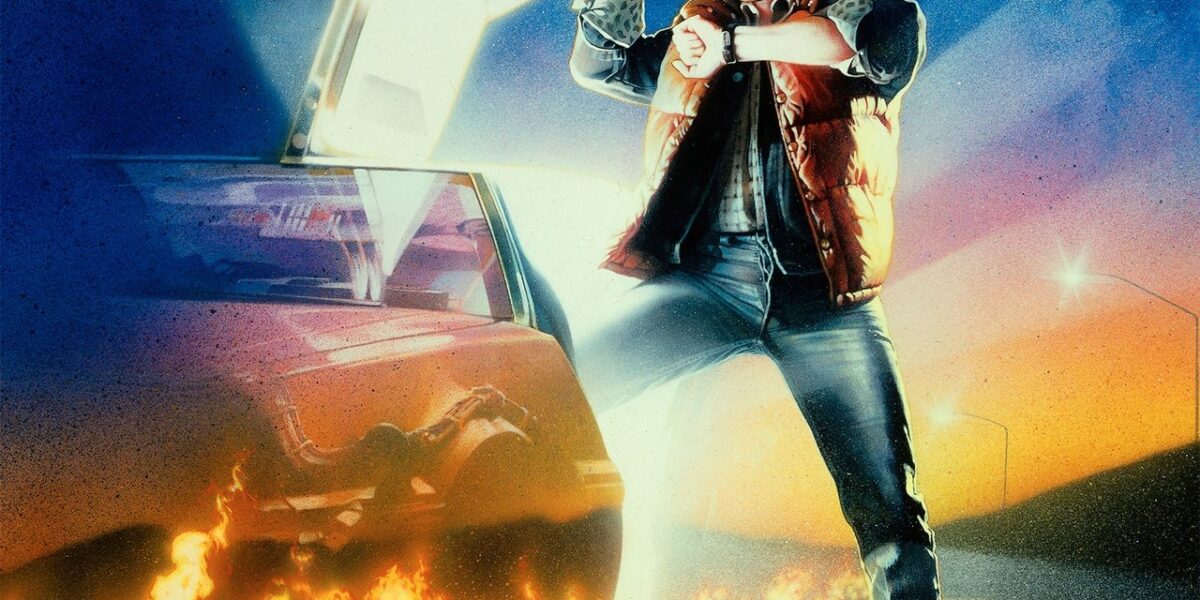
Back to the Future: Ending Explained — Ultimate Breakdown
Few endings in cinema history carry the weight of pure, euphoric invention that Back to the Future delivers in its final minutes. Robert Zemeckis crafted not merely a time-travel adventure but a meditation on identity, causality, and the terrifying fragility of the lives we inherit. What appears to be a crowd-pleasing resolution conceals layers of philosophical provocation that reward those willing to look beyond the spectacle.
Back to the Future: What happens at the end
After engineering the Enchantment Under the Sea dance so that George McFly and Lorraine Baines finally kiss and fall in love, Marty McFly races the DeLorean toward the clock tower at precisely the right moment. Lightning strikes, the flux capacitor activates, and Marty is hurled back to 1985 — materializing in the parking lot of the Twin Pines Mall, which now carries the revised name Lone Pine Mall, a quiet testament to the altered past he has already set in motion.
Returning home, Marty discovers his family has been transformed. George is now a confident, published science-fiction author. Lorraine is vibrant and self-assured. His siblings, once underachieving and defeated, radiate success. Then Doc Brown reappears in the DeLorean, urgently demanding Marty join him — because something has gone wrong in the future. The sequel hook lands with electrifying precision, refusing to let the audience fully exhale.
The deeper meaning
The ending of the film is not truly about time travel — it is about the courage required to rewrite inherited failure. Marty arrives home to find that his family’s mediocrity was never destiny; it was simply the residue of one unconfident man who never stood up for himself. The metaphor is devastating in its simplicity: the lives we are born into are not fixed truths but consequences of choices that could, in theory, always have been made differently.
Zemeckis uses the altered McFly household as a visual argument against fatalism. Every detail — George‘s writing trophies, the pristine truck in the driveway — functions as evidence that confidence and decisive action compound across time. The director’s intention is to leave the audience simultaneously comforted and unsettled, asking a quietly radical question: if your parents had made different choices, would the person you are today still exist at all?
Hidden details & easter eggs
The name change from Twin Pines Mall to Lone Pine Mall is one of cinema’s most elegant pieces of foreshadowing deployed retroactively — Marty ran over one of old Peabody‘s pine saplings when the DeLorean first activated in 1955, and the present world quietly acknowledges this without fanfare. Additionally, the clock tower frozen at 10:04 PM appears in the background of the final sequence, a visual anchor connecting the film’s opening tension to its resolution, rewarding observant viewers with a silent, circular satisfaction.
Connections to the rest of the film
The film establishes early that the McFly family suffers from a deeply embedded pattern of passivity — George is bullied by Biff Tannen, Lorraine drinks, and Marty himself fears rejection so profoundly he avoids submitting his music. The ending inverts every single one of these failures simultaneously. This is not coincidence but architectural storytelling: Zemeckis and co-writer Bob Gale constructed the opening act as a precise inventory of wounds that the ending methodically heals, making the resolution feel emotionally inevitable rather than conveniently happy.
Fan theories
One compelling theory suggests that the real Marty McFly ceased to exist the moment history changed, and the young man who returns home is technically a different person — one raised by a confident father, shaped by entirely different childhood experiences. The evidence is persuasive: why would this Marty still know Doc Brown? A counterargument holds that Zemeckis intentionally left this ambiguity unresolved, treating personal continuity as a feeling rather than a verifiable fact, which makes the film philosophically richer than any clean answer could. You can find the film catalogued on IMDB alongside decades of fan discussion exploring exactly this tension.
FAQ
Why does the mall’s name change at the end of Back to the Future?
When Marty travels to 1955, he accidentally destroys one of Peabody‘s twin pine trees while escaping in the DeLorean. Because that event now exists in the past, the mall in the altered 1985 is called Lone Pine Mall instead of Twin Pines Mall.
Does Doc Brown actually die at the end?
Doc Brown is shot by the Libyans moments before Marty departs for 1985, but when Marty returns he finds Doc alive — protected by a bulletproof vest Doc wore after reading Marty’s warning letter, which he had secretly taped back together after initially tearing it up.
Why is Marty’s family so different when he returns?
By ensuring his parents fell genuinely in love at the Enchantment Under the Sea dance, Marty gave his father George the confidence he originally lacked. That single act of courage rippled forward through decades, producing a measurably more successful and happier family unit by 1985.
What has gone wrong in the future that Doc mentions?
Doc arrives urgently needing Marty and Jennifer to travel to 2015 to prevent a crisis involving their future children. This crisis forms the premise of Back to the Future Part II, though the original film treats it deliberately as a thrilling open question rather than a resolved plot point.
Is the ending of Back to the Future actually a happy one?
On the surface, yes — the family is restored and improved. But the ending subtly raises the question of whether the Marty who returned is truly the same person who left, since he grew up in a fundamentally different household. Zemeckis never resolves this, which is precisely what makes it linger.