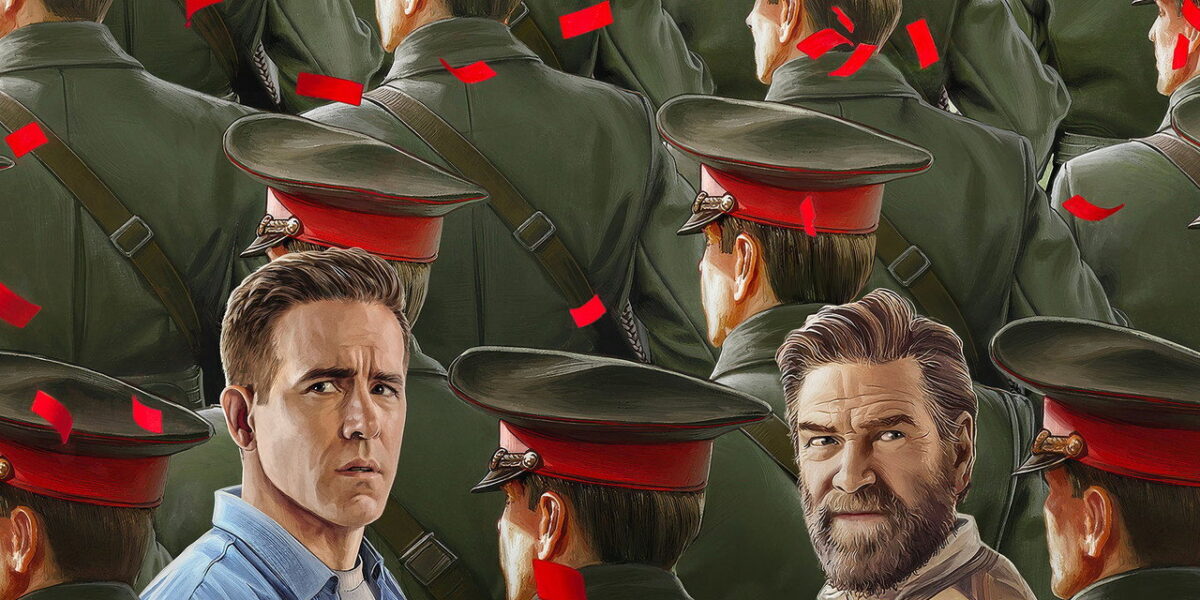
Mayday: Ending Explained — Ultimate Breakdown
Few Cold War thrillers dare to smuggle genuine emotional weight beneath layers of deadpan comedy, but Jonathan Goldstein‘s Mayday does exactly that. What begins as an absurdist survival story — a U.S. Navy pilot stranded behind enemy lines, forced into an impossible alliance — reveals itself as a profound meditation on trust, identity, and the arbitrary borders that divide human beings. This analysis dives deep into the film’s final act, unpacking every choice with the scrutiny this audacious movie deserves.
Mayday: What happens at the end
In the film’s closing sequence, the American pilot — played with remarkable restraint and wit by Ryan Reynolds — finally secures the intelligence package that justified his entire top-secret mission. However, the extraction goes catastrophically wrong. Soviet forces close in, and the carefully constructed escape route collapses entirely. It is at this precise moment of maximum danger that the eccentric ex-KGB agent, portrayed with extraordinary depth by Marcin Dorociński, makes a choice that defies every institutional loyalty he has ever known.
Rather than surrendering the American to save himself, Dorociński’s character engineers a breathtaking diversion — sacrificing his own freedom, and arguably his own future, to guarantee the pilot’s survival. The final frames show Reynolds‘s character aboard a rescue aircraft, clutching the intelligence package, staring back toward the landscape below with an expression that communicates something far more complex than relief. The tagline — “A friendship with major red flags” — lands its full devastating irony only here, in this silence.
The deeper meaning
The ending weaponizes the concept of the red flag against itself. Throughout the film, every ideological difference between the two men — every moment of suspicion, every cultural collision — has been framed as a potential threat. Goldstein‘s masterstroke is revealing that these so-called red flags were never dangers at all; they were the precise texture of authentic human connection. The film argues, with quiet ferocity, that genuine trust is only possible between people who have genuinely risked betraying each other.
The director’s intention runs deeper than buddy-comedy mechanics. By setting the story during the Cold War — humanity’s most elaborate theater of mutual suspicion — Goldstein transforms the personal into the geopolitical. The alliance between these two men becomes a metaphor for every diplomatic impasse, every ideological wall, every moment where institutional hatred has smothered individual humanity. The film insists that systems divide; people, given half a chance, connect. That is its most radical and most hopeful argument.
Hidden details & easter eggs
Attentive viewers will notice that Dorociński’s character carries a specific lighter throughout the film — one that appears in the background of an early scene, resting on a table beside American intelligence photographs. This is not accidental production design. The lighter reappears in the final act at the exact moment of sacrifice, functioning as a quiet visual callback that rewards rewatching. Similarly, Kenneth Branagh‘s supporting role contains a recurring motif of doors — always entering, never exiting — that presages the film’s themes of entrapment and liberation with elegant economy.
Connections to the rest of the film
The ending’s emotional power is only fully legible against the film’s carefully constructed foreshadowing. In an early scene, Dorociński’s character tells Reynolds, almost casually, that loyalty to a system is the coward’s version of loyalty. At the time, it reads as a throwaway philosophical provocation. By the final act, it functions as the film’s thesis statement, planted with surgical precision. David Morse‘s recurring presence as a figure of institutional authority similarly gains retrospective weight — he represents everything the ending ultimately rejects in favor of something irreducibly human.
Fan theories
One compelling theory circulating among audiences holds that Dorociński’s character never intended to escape at all — that his sacrifice was pre-planned from the moment he first agreed to the alliance. Evidence includes his curiously calm demeanor during the extraction sequence and a line of dialogue where he references “finishing things properly.” Against this reading, however, stands the genuine panic visible in his performance during the Soviet encirclement, suggesting the sacrifice was impulsive rather than calculated. Maria Bakalova‘s character, meanwhile, has generated a separate theory entirely: that she functions as a double agent whose true allegiances remain deliberately unresolved by design.
FAQ
Does the ex-KGB agent survive at the end of Mayday?
His fate is deliberately left ambiguous. He is last seen surrounded by Soviet forces, having ensured the American pilot’s escape, but the film never confirms whether he is captured, killed, or somehow evades capture through means the audience is not shown.
What does the final shot of Ryan Reynolds’s character mean?
The lingering expression on Reynolds‘s face as the aircraft departs communicates guilt, gratitude, and moral complexity simultaneously — the film refuses a clean emotional resolution, insisting the audience sit with the cost of survival when someone else paid the price.
What is the significance of the tagline “A friendship with major red flags”?
The tagline operates on a double meaning: “red flags” refers both to the warning signs of an untrustworthy alliance and, more pointedly, to the Soviet ideology that made their friendship institutionally impossible, transforming a comic phrase into the film’s central political irony.
Is Mayday based on a true story?
The film is not based on a single documented event but draws atmospherically from the documented history of Cold War intelligence operations, backroom diplomacy, and the numerous real cases of ideological defection and cross-enemy cooperation that official histories rarely celebrate.
What role does Kenneth Branagh play in the ending?
Branagh‘s character represents the institutional machinery that set the mission in motion — and his conspicuous absence from the film’s final sequence is itself a statement, suggesting that the human resolution of the story exists entirely outside the system that created the crisis.
You can explore cast and production details for this film on IMDB.