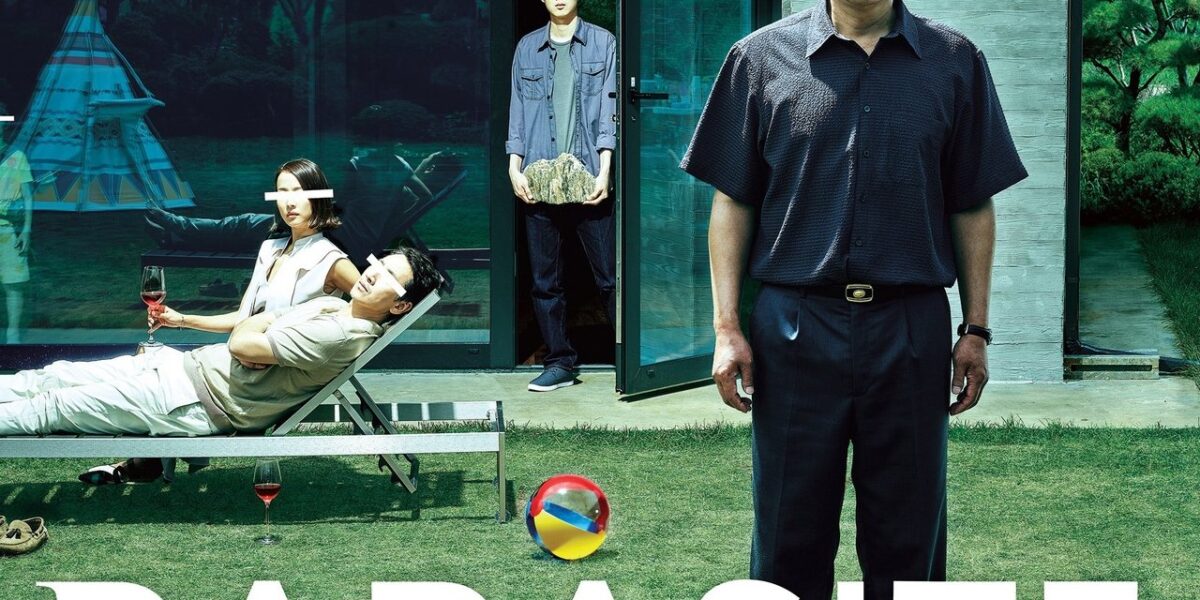
Parasite: Ending Explained — Ultimate Breakdown
Parasite, Bong Joon Ho’s 2019 Palme d’Or and Oscar-winning masterpiece, doesn’t simply end — it detonates. What begins as a darkly comic tale of class infiltration spirals into something far more visceral and unforgiving. The film’s final act forces us to confront an uncomfortable truth: in a society built on vertical inequality, the only direction available to the poor is downward. This article dissects every layer of that devastating conclusion.
Parasite: What happens at the end
During a garden party at the Park mansion, the hidden basement dweller Moon-gwang‘s husband Geun-se escapes his underground prison and attacks the Kim family. Ki-woo is struck with a scholar’s rock, leaving him critically wounded. Ki-jung is stabbed repeatedly by Geun-se. In the chaos, Ki-taek watches his daughter bleed out as the wealthy Mr. Park reacts to the scene with naked disgust — prioritizing his driver’s car keys over a dying child. That single gesture of callous indifference becomes the breaking point of the entire narrative.
In a moment of cold, irreversible clarity, Ki-taek plunges a knife into Mr. Park, killing him. He then vanishes — disappearing into the bunker beneath the house, inheriting Geun-se‘s underground existence. Weeks later, Ki-woo survives his injuries and, in a bittersweet epilogue, reads a Morse code message from his father hidden beneath the now-sold mansion. Ki-woo imagines saving enough money to buy the house and free his father — but Bong Joon Ho makes clear this fantasy will almost certainly remain exactly that: a dream pressed against bulletproof glass.
The deeper meaning
The film’s ending is a ruthless dissection of class immobility. The metaphor of the underground bunker is almost too precise to bear — the poor don’t simply live below the wealthy, they are structurally buried beneath them, invisible and forgotten. Ki-taek‘s descent into the basement isn’t a choice born of madness; it is the logical conclusion of a system that was never designed to let him rise. The house, with its pristine upper floors and rotting underbelly, is South Korean society rendered in architectural form.
Bong Joon Ho has spoken openly about his intention to portray capitalism not as a villain with a face, but as a systemic condition that produces villains as a byproduct. Mr. Park‘s fatal flaw isn’t cruelty — it’s the unconscious, almost innocent obliviousness of someone who has never had to see people like Ki-taek as fully human. That obliviousness, Bong argues, is more dangerous than any deliberate malice. It is the true parasite of the title — feeding on human dignity without even noticing it feeds. You can find the film listed on IMDB alongside its full critical legacy.
Hidden details & easter eggs
The scholar’s rock — the suseok — carries devastating foreshadowing weight throughout the movie. Presented as a gift symbolizing wealth and prosperity, it becomes the instrument of Ki-woo‘s near-death. Bong also plants a crucial visual cue in the flooding sequence: water, the great social equalizer, destroys the Kims’ semi-basement home while the Parks sleep soundly above. Every architectural detail in the film is deliberate — notice how the Parks’ home is flooded with natural light while the Kim family’s windows frame only feet and pavement, a quietly devastating commentary on visibility and social standing.
Connections to the rest of the film
The ending reframes every earlier scene with surgical precision. Ki-taek‘s repeated observation that Mr. Park “never crosses the line” with his employees reads differently once we understand that the line, for Mr. Park, is not moral but olfactory — he is repulsed by the smell of poverty. This foreshadowing is embedded in multiple earlier exchanges, culminating in Mr. Park‘s visible disgust at the garden party. The smell metaphor — perhaps the film’s most devastating recurring motif — ultimately signs Ki-taek‘s death warrant for his employer long before the knife does.
Fan theories
One compelling theory argues the entire epilogue — Ki-woo‘s imagined rescue of his father — is not presented as fantasy but as delusion, suggesting Ki-woo suffered lasting neurological damage from the scholar’s rock attack, rendering his optimism pathological rather than hopeful. Evidence supports this: the sequence is bathed in warm, unrealistic light. A contrasting theory reads the ending as genuinely ambiguous, leaving open the statistical improbability rather than impossibility of escape. A third, darker interpretation holds that Ki-taek has fully become Geun-se — a new generation of the buried poor, waiting for a son who will never arrive.
FAQ
Does Ki-taek ever escape the bunker at the end of Parasite?
As of the film’s ending, Ki-taek remains hidden in the bunker beneath the sold Park mansion. His escape is only depicted as Ki-woo‘s imagined future — a dream sequence, not a confirmed event, making his liberation deliberately uncertain.
Why does Ki-taek kill Mr. Park?
Ki-taek snaps when Mr. Park recoils in disgust at Geun-se‘s smell — the same smell associated with the Kim family — while his daughter Ki-jung lies dying nearby. It is the final, unbearable confirmation that to Mr. Park, the poor are fundamentally beneath consideration.
What does the scholar’s rock symbolize in the film?
The suseok represents the false promise of prosperity handed down to those without power. Initially gifted as a token of good fortune, it is wielded as a weapon against the very family it was meant to elevate, exposing the violence embedded in class aspiration.
Who is the real “parasite” in the movie?
Bong Joon Ho deliberately leaves this question open. The Kims infiltrate the Parks, but the Parks unconsciously drain the dignity and labor of the poor. The title implicates both — and ultimately indicts the economic system that forces this symbiosis into existence in the first place.
Is the ending of Parasite hopeful or pessimistic?
It is precisely and purposefully both. Ki-woo‘s letter expresses genuine love and determination, but the economic math of his plan is impossible on his current trajectory. Bong Joon Ho gifts us the emotion of hope while structurally dismantling any rational basis for it.