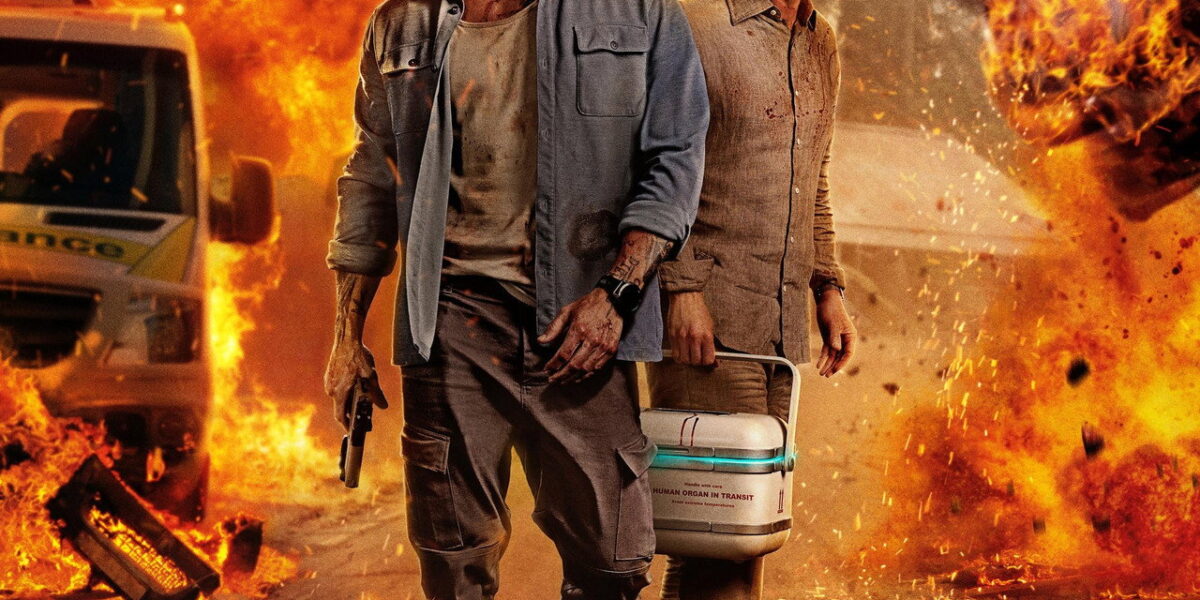
Runner: Ending Explained — Ultimate Breakdown
Few action-comedies dare to wrap a genuinely emotional payload inside the explosive machinery of a chase film, yet Runner does exactly that. Directed by Scott Waugh — a filmmaker who understands kinetic tension in his bones — this 2026 adrenaline ride culminates in a finale that demands more than a casual viewing. Here, we dissect every layer of that ending: what literally happens, what it symbolically means, and why it resonates so deeply beyond the gunfire and dark humor.
Runner: What happens at the end
In the film’s climactic stretch, Jake — Alan Ritchson‘s battle-scarred former soldier — and his reluctant partner Danny, played with disarming charm by Owen Wilson, finally breach the cartel’s last defensive perimeter. The medical package, battered and miraculously intact after a relentless gauntlet of ambushes and double-crosses, reaches the hospital. The little girl receives her life-saving medication in a sequence Scott Waugh frames with quiet, almost reverent restraint — a deliberate exhale after two hours of held breath.
The final twist arrives not with a bullet but with a revelation: the operative who had been feeding the cartel intelligence is exposed as someone within Jake‘s own support network, a betrayal seeded throughout the film’s middle act. Rather than executing vengeance, Jake makes the unexpected choice to walk away, leaving justice to the institutions he once served. Danny, standing beside him, delivers the film’s closing line — a deceptively simple joke that lands with the weight of genuine emotional catharsis.
The deeper meaning
At its core, Runner uses the metaphor of delivery — of physically carrying something precious across impossible distance — to explore what it means to maintain purpose after trauma. Jake is not simply transporting medicine; he is transporting his own capacity for selfless commitment, a quality the military extracted and the civilian world never knew how to receive. The little girl is almost a symbol: innocence that still merits protection in a world designed to grind it away.
Scott Waugh has consistently been interested in duty as identity — think of how his earlier work frames soldiers less as heroes than as men searching for a function that justifies their damage. Here, the director pushes that thesis further by introducing comedy as a structural argument: if Danny‘s irreverence can coexist with Jake‘s severity, then levity and grief are not opposites but traveling companions, both necessary to survive the road.
Hidden details & easter eggs
Attentive viewers will notice that the medical case bears a small, almost illegible sticker of a running figure — the same icon used on the cartel’s internal documentation shown briefly in act one, suggesting the organization itself originally commissioned the very supply chain it later tries to destroy. Additionally, Danny‘s wristwatch stops at exactly the moment the betrayer makes first contact, a visual foreshadowing device that rewards repeat viewing and rewards audiences who suspect Waugh planted the clue intentionally. The color palette also shifts — warm amber to cold steel — each time loyalty fractures on screen.
Connections to the rest of the film
The ending’s emotional power is inseparable from an early scene in which Jake admits to Danny that he has never once delivered anything on time — a confession played for laughs but functioning as devastating foreshadowing. When the delivery ultimately succeeds, that confession is retroactively redeemed. Similarly, the traitor’s identity recontextualizes every moment of tactical advice given in the film’s second act, transforming what felt like competent exposition into a sophisticated web of dramatic irony that the script had been quietly constructing all along.
Fan theories
One compelling theory argues that Danny is himself a planted asset — his convenient expertise and perfectly timed appearances throughout the chase suggesting coordination rather than coincidence. Evidence supports this: he knows the cartel’s secondary routes without explanation. Against it: his genuine panic in the tunnel sequence is difficult to fake. A second theory proposes that the little girl is Jake‘s biological daughter, never named aloud, explaining his ferocity. The film neither confirms nor denies this, and Waugh has remained deliberately silent, which is itself a kind of answer. You can explore cast details on IMDB.
FAQ
Does the little girl survive at the end of Runner?
Yes. Jake and Danny successfully deliver the medication in time, and the film confirms her survival through a brief but emotionally conclusive hospital scene before the credits roll.
Who is the traitor in Runner?
The traitor is a trusted operative within Jake‘s support network — someone with intimate knowledge of the mission’s logistics — whose identity is concealed until the final act through careful misdirection.
Does Jake take revenge on the traitor?
No. In a defining character moment, Jake chooses not to pursue personal vengeance, instead leaving accountability to external authorities — a choice that signals genuine psychological growth for the character.
What does the ending of Runner say about Jake’s arc?
Jake‘s arc concludes with him rediscovering purposeful action untethered from institutional violence. Completing the delivery restores his sense of identity in a way combat never fully could.
Is there a post-credits scene in Runner?
The film includes a brief post-credits moment featuring Danny attempting — and hilariously failing — another delivery job, which functions as both comic relief and an open door for a potential sequel.