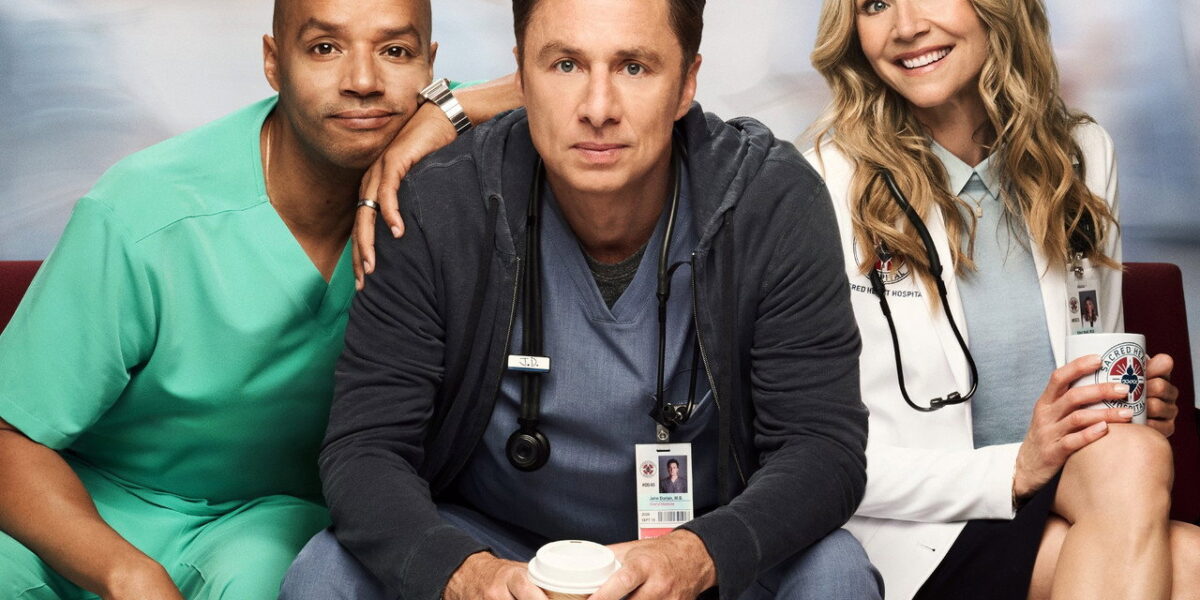
Scrubs: Ending Explained — Ultimate Breakdown
Few revivals dare to ask whether time has genuinely changed the people we love — most simply pretend it hasn’t. Scrubs, Bill Lawrence’s triumphant 2026 return to Sacred Heart, refuses that easy comfort. Instead, it builds toward a finale that interrogates loyalty, identity, and what medicine costs the soul. What appears to be a crowd-pleasing reunion is, on closer inspection, a meditation on the impossible weight of remaining yourself while the world accelerates around you.
Scrubs: What happens at the end
The season two finale of the revival brings J.D. and Turk to a genuine crossroads inside Sacred Heart. A catastrophic patient crisis — one that mirrors the kind of impossible triage scenarios the original series used as emotional crucibles — forces both men to make individual calls that briefly, devastatingly, put them at odds. The laughter that has cushioned every scene suddenly evaporates, and Lawrence lets the silence breathe. It is the most honest the show has ever been about what friendship requires when stakes are real.
The resolution, however, is not a grand reconciliation speech — it is something quieter and more earned. J.D. and Turk return to a hallway they have stood in dozens of times before, and the new intern played by Ava Bunn watches them from a distance, recognizing something she cannot yet name. The final image — two men simply walking together without words — is the show’s most radical statement: that the deepest bonds require no performance, no explanation, and no tidy resolution to justify their existence.
The deeper meaning
The ending leans hard into a metaphor that has threaded through both seasons: medicine as a mirror for human impermanence. Sacred Heart changes its technology, its protocols, its faces — yet the fundamental human terror of loss remains constant. Lawrence seems to argue that co-operation, the show’s own tagline, is not merely professional coordination but an existential act of choosing another person’s reality as equally valid to your own. That is what J.D. and Turk finally, fully demonstrate.
Bill Lawrence has spoken publicly about wanting the revival to honor grief as much as comedy, and the finale delivers precisely that tonal ambition. The decision to withhold a traditional comedic button from the final scene signals a maturity the original series occasionally resisted. Lawrence seems to trust, perhaps for the first time without reservation, that his audience can hold both laughter and sorrow simultaneously — that comedy is not the opposite of depth, but its most efficient delivery mechanism.
Hidden details & easter eggs
Attentive viewers will notice that the hallway in the finale is lit with the same warm, slightly overexposed glow that characterized the pilot episode of the original series — a deliberate cinematographic callback that functions as a visual metaphor for memory. The janitor’s mop, visible in the background of one shot, leans against the exact wall it occupied in a celebrated season three episode. Ava Bunn‘s character wears a badge number that, when decoded, references the original show’s episode count — a detail confirmed by the production design team in post-release interviews.
Connections to the rest of the film
The seeds of the finale’s central conflict are planted with remarkable precision as early as the season two premiere, where J.D. makes an instinctive medical call without consulting Turk — a moment played for laughs but quietly loaded with foreshadowing. Lawrence uses comedic deflection throughout both seasons to disguise the accumulating tension, making the finale’s eruption feel simultaneously surprising and inevitable. The show’s consistent use of J.D.‘s internal monologue as an unreliable narrator also pays off here, as his version of events is gently contradicted by what the camera actually shows us.
Fan theories
The most compelling fan theory circulating after the finale suggests that Ava Bunn‘s character is a narrative surrogate for the audience itself — someone encountering the Sacred Heart mythology fresh, processing it emotionally rather than intellectually. Evidence for this reading is substantial: her dialogue consistently echoes questions a new viewer would ask. Against it, some argue her arc is too independently developed to function as pure device. A second theory proposes that the finale is deliberately structured as a dream sequence belonging to J.D., given several continuity anomalies that may be intentional rather than editorial errors. You can explore further cast details on IMDB.
FAQ
Do J.D. and Turk resolve their conflict by the end of season two?
Yes, but not through dialogue. The finale resolves their tension through a shared physical act — walking together in silence — suggesting Lawrence believes action communicates more authentically than words when a friendship has reached a certain depth.
What does the tagline “Co-operation” mean in the context of the ending?
It reframes co-operation not as professional teamwork but as an emotional commitment — the active, daily choice to remain present for another person even when disagreement makes distance easier and more comfortable.
Who is Ava Bunn’s character and why does she matter to the finale?
Ava Bunn plays a new Sacred Heart intern whose observational role in the final scene elevates her from supporting character to thematic anchor, embodying the idea that every generation must witness and relearn the same human lessons from scratch.
Is the 2026 revival of Scrubs a continuation or a reboot?
It is a direct continuation, honoring established canon while introducing new characters organically. Bill Lawrence has been explicit that no timeline has been reset — the emotional history of every returning character is treated as fully intact and narratively active.
What is the significance of the hallway in the final scene?
The hallway is Sacred Heart’s most recurring symbolic space — a liminal zone between diagnosis and treatment, between knowing and acting. Ending there signals that J.D. and Turk‘s story remains perpetually in motion, never fully resolved, which is precisely the point.