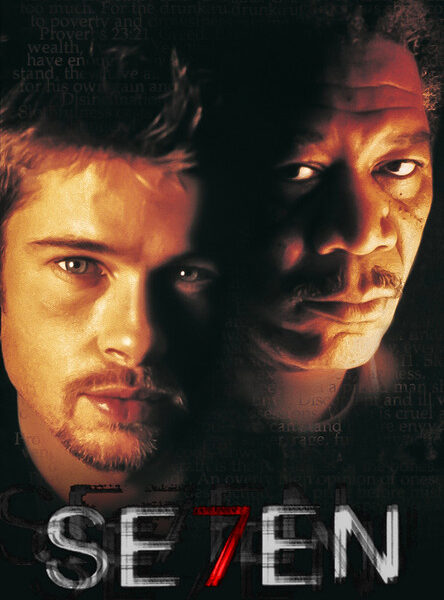
Se7en: Ending Explained — Ultimate Breakdown
Few endings in cinema history have detonated with the force of Se7en‘s final act. David Fincher’s 1995 masterpiece doesn’t simply conclude — it collapses inward like a dying star, leaving its audience shattered and philosophically unmoored. What happens in that scorched desert field is not merely a plot resolution but a moral catastrophe carefully engineered from the film’s very first frame. This analysis dismantles every layer of meaning hidden inside that infamous box.
Se7en: What happens at the end
After capturing the enigmatic killer John Doe, played with reptilian calm by Kevin Spacey, detectives Somerset and Mills are led to a remote desert location. A delivery van arrives carrying a mysterious box. John Doe confesses to Somerset that the box contains the severed head of Tracy Mills, Detective Mills‘s pregnant wife — completing the sin of Envy, as Doe envied Mills’s ordinary, loving life.
Somerset desperately attempts to talk Mills down, but the grief-obliterated detective shoots John Doe execution-style, fulfilling the killer’s final design: Mills becomes the embodiment of Wrath. John Doe achieves his grotesque masterpiece posthumously. Somerset, quoting Hemingway, tells the arriving officers he will remain in the area — a quiet, devastated man choosing to stay and bear witness to a world he finds increasingly impossible to endure.
The deeper meaning
The ending’s most devastating insight is this: John Doe wins. Not through survival, but through ideology. By engineering his own death at Mills‘s hands, he transforms his murder spree into a completed sermon. The seven sins are not merely his victims’ crimes — they are humanity’s inheritance. Fincher forces us to recognize that Wrath, the sin that destroys Mills, is the most universally relatable impulse of all, implicating the audience who silently rooted for the same outcome.
Fincher’s intention was never to deliver catharsis — it was to deny it entirely. The director weaponizes noir conventions against the viewer. We expect the hero to prevail through righteous violence; instead, righteous violence is precisely what the villain requires. Somerset‘s quiet choice to remain represents the only authentic moral response available: not triumph, not revenge, but a bruised, clear-eyed commitment to continuing in spite of everything.
Hidden details & easter eggs
The box itself is never shown on screen — a masterclass in negative space as narrative tool. Fincher understood that imagination conjures horrors no practical effect could match. Notably, Brad Pitt insisted on reading the original, darker script ending rather than studio-approved alternatives, personally advocating for this conclusion. The delivery driver’s nonchalance is deliberately mundane, echoing Hannah Arendt‘s concept of the “banality of evil” — monstrousness arriving in ordinary packaging on an ordinary afternoon in an ordinary van.
Connections to the rest of the film
Foreshadowing saturates the movie long before the desert. Somerset early on tells Mills directly: “This isn’t going to have a happy ending.” Tracy‘s private breakfast conversation with Somerset, where she reveals her pregnancy and her fear of raising a child in their city, retroactively transforms into a scene of unbearable grief. Even John Doe‘s surrender — too clean, too willing — signals from the beginning that the killer is not escaping the narrative but completing it on his own terms.
Fan theories
One compelling theory suggests Somerset knew what was in the box before Mills acted, and his hesitation was a moral calculation — allowing fate to complete itself. Evidence includes his prolonged positioning away from Mills. Countering this, his physical desperation reads as entirely genuine. A second theory proposes John Doe is a projection of Somerset‘s own darkest philosophical impulses — a shadow self embodying the cynicism Somerset resists. The film never fully contradicts this reading, which makes it hauntingly persuasive. Find the film listed on IMDB for further cast and production details.
FAQ
What is actually inside the box at the end of Se7en?
The box contains the severed head of Tracy Mills, Detective Mills’s pregnant wife. This is confirmed by John Doe‘s confession and Somerset‘s horrified reaction, though the contents are never shown on screen.
Why does Mills shoot John Doe if it means losing everything?
Because grief overrides reason. John Doe engineered the situation precisely so that no amount of rationality could suppress Mills‘s Wrath, proving his thesis that humanity cannot escape its sinful nature regardless of moral intent.
Does Somerset quit at the end of the film?
No — in a crucial reversal of his earlier planned retirement, Somerset tells the officers he will be “around.” It is a quiet act of defiance against despair, choosing engagement over withdrawal despite witnessing absolute horror.
Was John Doe’s plan always to be killed by Mills?
Yes. John Doe‘s surrender was entirely strategic. His death at Mills‘s hands was the seventh and final sin — Wrath — completing his living manifesto and ensuring his ideology outlasted his body.
What does the ending of Se7en say about justice?
The ending argues that conventional justice is an illusion in a corrupt world. The killer achieves his goal through the justice system’s own instruments, suggesting that moral certainty — not the law — is the only true protection against manipulation.