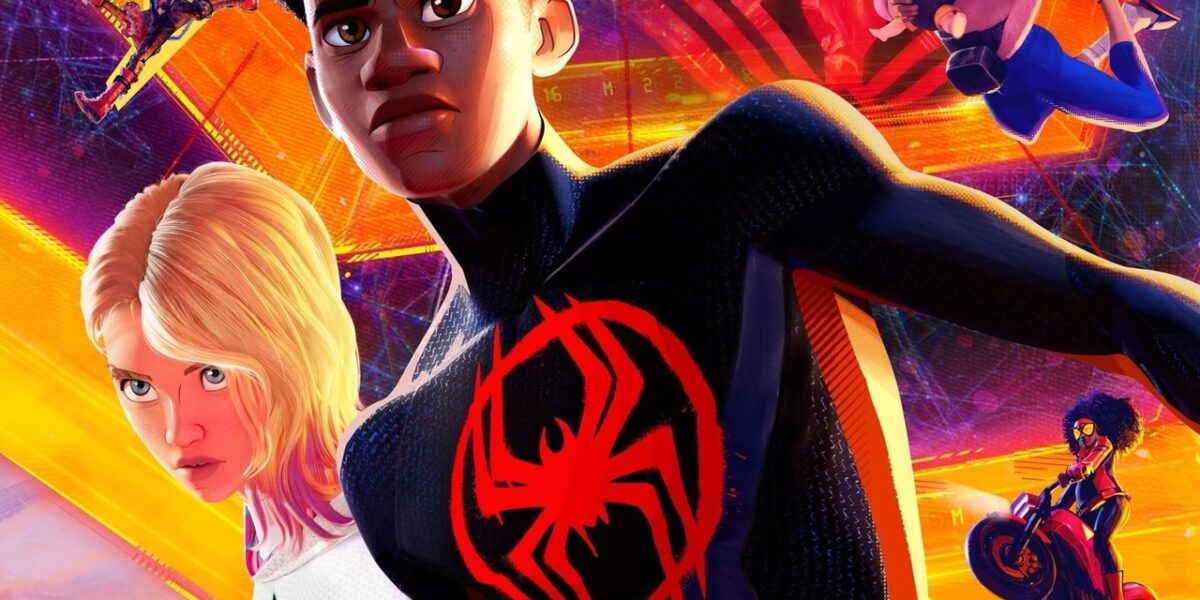
Spider-Man: Across the Spider-Verse: Ending Explained — Ultimate Breakdown
Spider-Man: Across the Spider-Verse doesn’t just end — it detonates. What begins as a multiverse adventure about belonging and legacy collapses into something far more radical: a story about whether fate itself can be defied. The film’s final act reframes everything we’ve witnessed as a philosophical confrontation between determinism and free will, daring to leave its hero — and its audience — suspended at the edge of an impossible choice.
Spider-Man: Across the Spider-Verse: What happens at the end
Miles Morales discovers the devastating truth: his father, Jefferson Davis, is fated to die — a so-called “canon event” that Miguel O’Hara (Spider-Man 2099) insists must not be altered. Every Spider-Person’s story, according to Miguel, is anchored by tragedy. Refusing to accept this, Miles breaks from the Spider Society entirely, triggering a stunning multiverse chase sequence that confirms his status not merely as a Spider-Man, but as something genuinely unprecedented.
The twist arrives with brutal elegance: Miles attempts to return home but lands in the wrong universe — Earth-42, a dimension where he was never bitten by a spider. Here, the radioactive spider that created him came from this world, meaning Earth-42 has no Spider-Man at all. The final image reveals Miles shackled, face to face with his alternate self: a dark, hardened version who has become the Prowler instead.
The deeper meaning
The Prowler-Miles mirror is one of modern animation’s most devastating uses of doppelgänger symbolism. It asks: without the right catalyst, does a hero become a villain? The film argues that identity is not destiny but choice — shaped by community, love, and the courage to reject what the universe demands of you. Miles represents the radical possibility that the “wrong” origin story can still produce the right person, if that person fights hard enough to define themselves.
Justin K. Thompson and the directing team embed a quiet but fierce metaphor throughout: the Spider Society’s rigid canonicity mirrors real-world institutional gatekeeping — the insistence that certain people simply don’t belong in certain roles. Miguel’s tragic backstory, in which he broke canon and lost everything, makes him a compelling antagonist precisely because his authoritarianism is born from grief, not malice. The film refuses easy villainy, forcing us to feel the weight of every position.
Hidden details & easter eggs
Attentive viewers will notice that Earth-42’s visual palette is deliberately desaturated — its colors muted, its lines harder, its world a stark contrast to the vibrant, painterly warmth of Miles‘s home dimension. This isn’t mere aesthetics; it’s a visual thesis. The spider bite didn’t just grant Miles powers — it injected color, possibility, and hope into his existence. There’s also a haunting detail: the Prowler of Earth-42 wears the same hoodie Miles wore in Into the Spider-Verse, suggesting the divergence point was heartbreakingly close. You can find more production details on IMDB.
Connections to the rest of the film
The ending recontextualizes an early piece of foreshadowing that most viewers miss on first viewing: when Miguel shows Miles the multiverse’s canon events, the film briefly flashes images of Spider-People defined by loss. The foreshadowing of Miles being an anomaly — a Spider-Man who was never supposed to exist — plants the seed for his Earth-42 imprisonment long before the finale. His entire arc is built on stolen possibility, and the film’s structure quietly, methodically prepares us for that revelation without ever telegraphing it clumsily.
Fan theories
One compelling theory suggests that Earth-42 Miles — the Prowler — will ultimately become an ally in Beyond the Spider-Verse, mirroring Uncle Aaron’s redemptive arc from the first film. Evidence supports this: the filmmakers are clearly fascinated by the Prowler legacy as a site of potential heroism. A counter-theory posits that Gwen Stacy’s newly formed team — glimpsed assembling at the film’s close — represents the real answer to institutional Spider-Society thinking, a found-family model that replaces Miguel’s authoritarian canon-worship with something more human and compassionate.
FAQ
Why does Miles end up in the wrong universe at the end?
The Go-Home Machine was sabotaged by Miguel to redirect Miles away from his home dimension. Because Miles is biologically coded to Earth-42 — the origin of the spider that bit him — the machine sent him there instead of Brooklyn.
Who is the Prowler at the end of the film?
The Prowler is an alternate version of Miles Morales from Earth-42, a dimension that never produced a Spider-Man. Without the spider bite’s catalyst, this Miles followed a darker path, becoming the very villain his prime-universe self once faced in the form of Uncle Aaron.
Is Miguel O’Hara a villain in Across the Spider-Verse?
Miguel functions as a tragic antagonist rather than a straightforward villain. His rigid enforcement of canon events stems from personal trauma — he once broke canon himself and suffered catastrophic loss, making his authoritarianism a form of unprocessed grief rather than pure malevolence.
What does the ending mean for Miles’s father, Jefferson?
The film establishes that Jefferson Davis dying is a supposed “canon event” that anchors Miles’s universe’s stability. The central dramatic question left unresolved is whether Miles can return in time to save him — and whether doing so would shatter reality or prove that canon can be rewritten.
Will there be a sequel that resolves the cliffhanger?
Yes — Spider-Man: Beyond the Spider-Verse is the direct continuation designed to resolve every thread left dangling here. The film was conceived as the second part of a two-part story, meaning this ending is deliberately incomplete, functioning as a midpoint climax rather than a true conclusion.