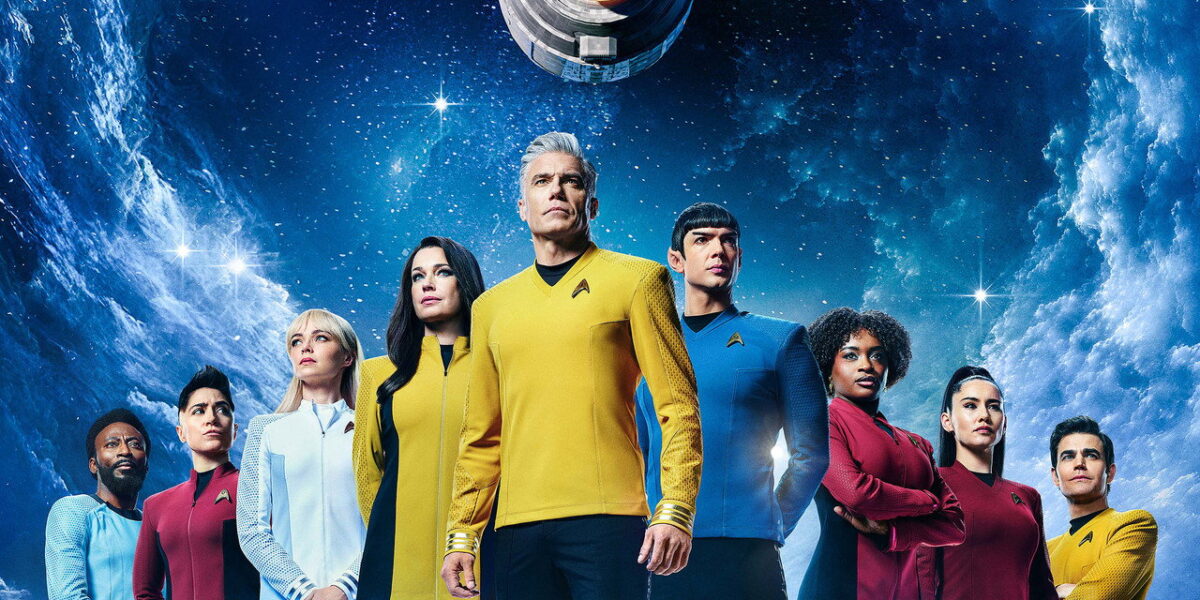
Star Trek: Strange New Worlds: Ending Explained — Ultimate Breakdown
Star Trek: Strange New Worlds is not merely a prequel exercise in nostalgia — it is a meditation on destiny, sacrifice, and the unbearable weight of foreknowledge. With Captain Christopher Pike at its helm, the series constructs one of the most emotionally sophisticated narrative architectures in modern science fiction television, daring to ask: what does it mean to live fully when you already know how the story ends?
Star Trek: Strange New Worlds: What happens at the end
Across its season finales, Strange New Worlds consistently returns to the same gravitational center: Pike‘s vision of his own disfigurement and death, and the moral consequences of that knowledge. The fourth season culminates in a convergence of temporal and emotional threads — Spock must navigate the razor’s edge between logic and feeling, while Number One confronts institutional loyalty versus personal truth, forcing every crew member to choose between comfort and conviction in ways that resonate far beyond the ship’s corridors.
The most devastating detail embedded in these finales is not the action itself, but the quiet acceptance radiating from Anson Mount‘s performance as Pike. He does not rage against his fate. He engineers moments of meaning around it, turning inevitability into a form of radical generosity. This is the show’s central twist — not a plot reversal, but a philosophical one: that knowing the ending does not diminish the journey. It consecrates it with unbearable, magnificent purpose.
The deeper meaning
The soul of this series is built on a single, aching metaphor: Pike‘s fixed fate as a mirror for the human condition itself. We all, in some sense, know our ending. The show’s genius lies in transforming this universal anxiety into a source of liberation rather than paralysis. Every exploration, every rescued civilization, every moment of connection aboard the Enterprise becomes an act of deliberate defiance against meaninglessness — a philosophy closer to Stoicism than standard adventure television ever dares to venture.
Creators Jenny Lumet, Alex Kurtzman, and Akiva Goldsman have spoken openly about their intention to restore Star Trek‘s foundational optimism while refusing to make that optimism naive or unearned. Their structural decision to anchor the series in Pike‘s foreknowledge gives every episode a tragic undertow that paradoxically makes the warmth feel more honest. The message is clear and quietly radical: courage is not the absence of fear or knowledge — it is the choice to act beautifully in spite of both.
Hidden details & easter eggs
Attentive viewers will note the careful visual foreshadowing scattered throughout the series — flickering lights that echo the communication device Pike will one day be confined to, or the recurring motif of Spock suppressing emotion in moments that directly rhyme with his characterization across the original Trek timeline. The production design team embeds Federation iconography from decades of franchise history with surgical precision, rewarding longtime fans without alienating newcomers. These are not mere fan-service gestures — they function as a visual grammar of destiny. You can find more context on IMDB.
Connections to the rest of the film
The series’ narrative architecture is built on an almost musical system of foreshadowing and callback. Pike‘s early monologue about choosing to embrace a known sacrifice finds its echo in nearly every subsequent episode, making each adventure feel like a variation on a single, elegiac theme. Ethan Peck‘s portrayal of a young Spock is perhaps the most sophisticated long-form character study in the franchise — every repressed reaction, every carefully chosen word is a brick in the emotional wall his future self will inhabit completely, making the connection between series and canon feel inevitable and earned.
Fan theories
The fan community has generated several compelling interpretations. The most persistent theory argues that Pike‘s visions are not fixed — that the show is quietly building toward a timeline divergence that will allow him to escape his canonical fate, supported by the series’ increasingly liberal treatment of temporal mechanics. A competing reading insists the opposite: that every attempted escape reinforces the inevitability, and the true ending will be Pike choosing his fate consciously. A third, darker theory suggests Number One‘s institutional secrets will ultimately catalyze the very accident that dooms him, adding a layer of tragic irony the narrative has carefully seeded.
FAQ
Does Captain Pike ultimately escape his canonical fate in Strange New Worlds?
As of the current seasons, Pike does not escape his fate. The show treats his foreknowledge as a fixed point — his arc is about choosing how to live within that certainty, not about dismantling it.
What does Spock’s emotional struggle represent thematically?
Spock‘s internal conflict between Vulcan logic and human feeling represents the series’ broader argument that neither pure reason nor pure emotion is sufficient — wisdom requires holding both in painful, productive tension.
Who is Number One and why does her storyline matter?
Number One, played by Rebecca Romijn, embodies institutional loyalty under pressure. Her secret Illyrian heritage forces the series to interrogate whether Starfleet’s ideals are genuinely universal or selectively applied to those who conform.
Is Strange New Worlds considered canon within the Star Trek universe?
Yes, the series is fully canonical, set in the Prime Timeline roughly a decade before The Original Series. Its events are designed to align with and enrich established franchise history rather than contradict it.
What makes the ending of each season emotionally effective?
Each finale derives its power not from shock but from inevitability rendered beautiful — the audience understands where these characters are heading, and the show transforms that knowledge into a source of profound, bittersweet emotional resonance.