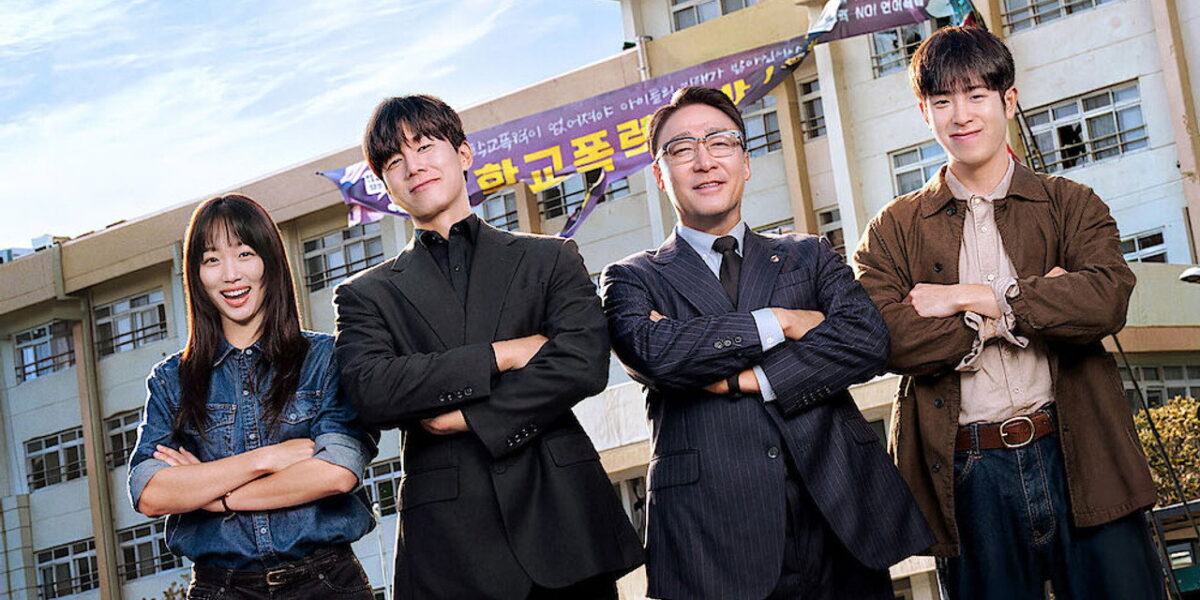
Teach You a Lesson: Ending Explained — Ultimate Breakdown
Teach You a Lesson — known in its original Korean title as 참교육 — arrives as one of 2026’s most electrifying surprises, blending brawling action with razor-sharp social commentary. The finale doesn’t merely close a chapter: it detonates a statement about authority, dignity, and what it truly means to protect the young. Here, we dissect every layer of that explosive conclusion and reveal what Hong Jong-chan, Lee Nam-kyu, and Kim Da-hee were really saying.
Teach You a Lesson: What happens at the end
The finale of Teach You a Lesson converges all threads inside the very institution where the inspectors began their mission. Kim Moo-yul‘s character — the uncompromising lead inspector — confronts the last remaining faction of corrupt school administrators who have been weaponizing student fear as a tool of control. The confrontation is physical, brutal, and deeply personal, staged in the school’s main corridor as a deliberate inversion of the opening scene’s helpless chaos.
The final twist arrives when Lee Sung-min‘s inspector, presumed to have abandoned the mission, reappears at the critical moment — not with fists, but with documented evidence that dismantles the institutional cover-up entirely. Jin Ki-joo‘s character, a student who had been both victim and reluctant witness throughout, is the one who hands over that evidence. The power is returned — not seized, but earned — and the gesture reframes every act of violence in the series as ultimately in service of this quiet, decisive moment.
The deeper meaning
At its core, the ending is a meditation on the collapse of institutional trust and who steps into that void. The inspectors are not saviors descending from above — they are mirrors, reflecting back to students a version of justice they had stopped believing in. The final image, a repaired school nameplate, functions as a metaphor for restoration that is imperfect but intentional, scarred but standing, much like every young person the series refused to abandon.
Directors Hong Jong-chan and Lee Nam-kyu have spoken in interviews about their desire to interrogate the hypocrisy embedded in educational authority. The ending embodies that intention with surgical precision: the system is not burned down, it is held accountable. That distinction is everything. It refuses the easy catharsis of destruction and insists instead on the harder, more adult work of repair — a thematically courageous choice that elevates the series far beyond its genre origins.
Hidden details & easter eggs
Viewers attentive to color will notice that throughout the series, corrupt authority figures are consistently framed against institutional blue — the color of bureaucratic coldness. In the finale, that blue is replaced by warm amber lighting the moment justice is restored, a chromatic shift so precise it reads as a directorial signature. Additionally, the school bell that rings during the climax chimes exactly as it did in the very first scene of the series, an auditory bookend that transforms an otherwise ordinary sound into a thunderclap of narrative closure.
Connections to the rest of the film
The series plants its most important foreshadowing early: in episode two, Pyo Ji-hoon‘s character offhandedly remarks that “the loudest classroom is always the most afraid.” That line, played for dark comedy at the time, becomes a devastating key to understanding every power dynamic explored thereafter. The finale’s quietest moment — a student’s silence in the face of an authority figure — directly echoes this, completing a thematic circuit that rewards patient, attentive viewing and proves the writing team’s architecture was meticulous from the very first frame.
Fan theories
One prominent fan theory argues that Lee Sung-min‘s late arrival in the finale is not coincidence but a planted double identity — that his character was always an internal investigator working a parallel operation. Evidence includes his conspicuous absence from several key confrontations and a brief phone call in episode four whose other end is never revealed. Against this theory stands the emotional arc of his character, which reads far more convincingly as genuine doubt and redemption rather than a calculated long game. A second theory suggests Jin Ki-joo‘s character will become an inspector herself in a potential second season, supported by the final shot lingering on her eyes rather than the restored nameplate — a gaze that carries unmistakable purpose and hunger for something beyond survival. You can explore more cast and production details on IMDB.
FAQ
Does the ending of Teach You a Lesson set up a second season?
The finale resolves its central conflict but deliberately leaves Jin Ki-joo‘s character at a narrative threshold, suggesting a potential continuation. No second season has been officially confirmed, but the open-ended final shot strongly implies one is intended.
Why does Lee Sung-min’s inspector disappear before the final confrontation?
His absence serves as the series’ most carefully constructed emotional misdirect. Rather than abandoning the mission, he was securing the documentary evidence that ultimately proves more powerful than any physical confrontation — making his return the episode’s true climactic blow.
What does the repaired school nameplate symbolize at the end?
It functions as a metaphor for institutional accountability: not erased or replaced, but visibly mended. The imperfection of the repair is intentional, signaling that justice leaves marks and that genuine restoration is never seamless or painless.
Is Teach You a Lesson based on a webtoon or original story?
The series is based on the acclaimed Korean webtoon 참교육, which developed a passionate readership for its unflinching portrayal of school violence and systemic failure. The adaptation expands several character arcs while preserving the source material’s uncompromising moral core.
What is the significance of the school bell ringing during the climax?
The bell mirrors its first appearance in the opening scene, creating a deliberate narrative symmetry. In the beginning it signals chaos and fear; in the finale it signals the restoration of order — transforming a routine sound into the series’ most quietly devastating symbol of change.