Forrest Gump: Ending Explained — Ultimate Breakdown
Forrest Gump is one of those rare films that disguises its philosophical depth beneath a deceptively simple surface. Robert Zemeckis crafted a story that ends not with triumph or defeat, but with something far more devastating and beautiful: the quiet continuation of life. The final act demands to be read carefully, because every image, every whispered word, every feather carried by the wind carries the weight of an entire American century compressed into one extraordinary, ordinary man.
Forrest Gump: What happens at the end
Jenny and Forrest finally marry, fulfilling a lifelong dream that has haunted every frame of the movie. Their reunion is tender and earned, yet shadowed from the start. Jenny reveals she is ill with an unspecified virus — widely interpreted as HIV/AIDS — and dies shortly after. Forrest is left a widower, raising their son Forrest Jr. alone in the house where he grew up, continuing life with the same unshakeable grace that has always defined him.
The film closes on a profoundly poetic image: Forrest watches his son board a school bus for the first time, and a single white feather lifts from the boy’s book, rising into a clear blue sky. It is the same feather that opened the film, now transformed in meaning. This is not a random visual flourish — it is the movie’s closing argument about fate, freedom, and the unstoppable forward motion of human life.
The deeper meaning
The white feather is the film’s central metaphor, and its return at the ending crystallizes everything Zemeckis has been building. It represents the tension between destiny and chance — the eternal philosophical question of whether our lives follow a predetermined path or drift helplessly on random winds. Forrest himself embodies this paradox: a man who seems to stumble into greatness yet does so with an almost divine consistency, as if the universe bends gently around his goodness.
Zemeckis’s intention is to challenge the viewer’s comfortable assumptions about intelligence, success, and meaning. By filtering fifty years of American history through Forrest‘s uncomplicated gaze, the director reveals how much of what we call wisdom is simply noise. The ending suggests that love, loyalty, and presence — showing up fully for another person — constitute the only form of heroism that actually matters. It is a quietly radical statement disguised as sentimental Americana.
Hidden details & easter eggs
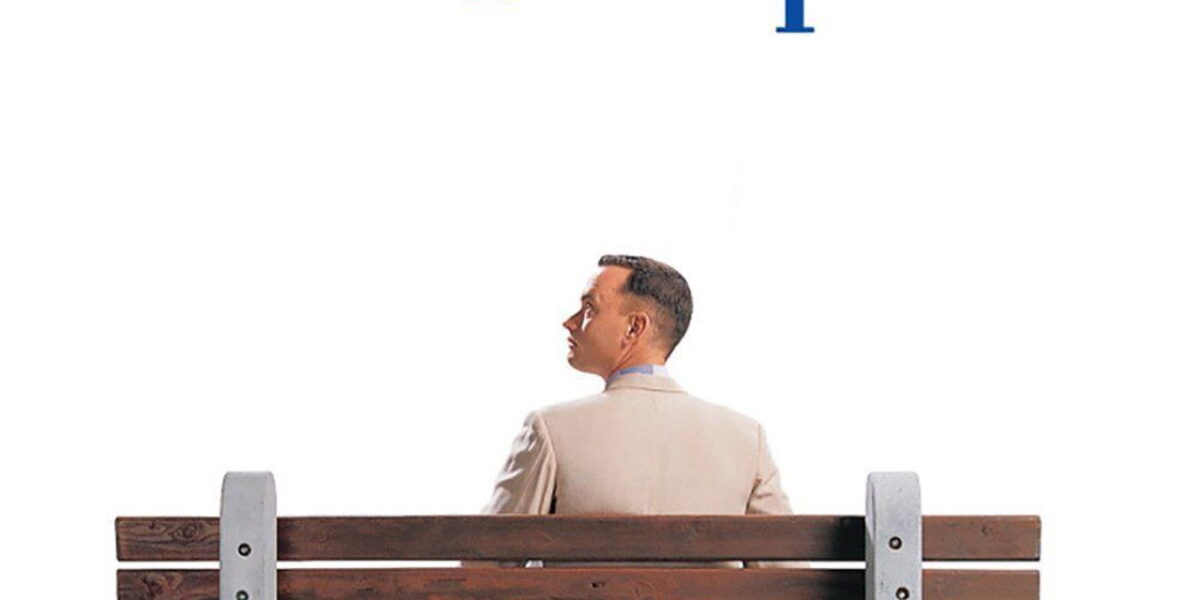
Look closely at the book Forrest Jr. carries onto the bus: it is Curious George, a detail that quietly rhymes with Forrest‘s own childlike wonder and insatiable curiosity about the world. Additionally, the bench where Forrest narrates his story throughout the film sits outside the Savannah History Museum — a deliberate choice, placing his tale literally inside the architecture of historical memory. The chocolate box, famously quoted, appears again near the ending as a visual callback, reinforcing the film’s governing philosophy about life’s unpredictability.
Connections to the rest of the film
The feather’s opening flight establishes a foreshadowing loop that only resolves completely in the final seconds. Throughout the movie, Forrest‘s life repeatedly defies expectation — from running through a football field to crossing Vietnam unscathed — each episode echoing the feather’s improbable, weightless journey. Jenny‘s death, meanwhile, was seeded as early as her childhood scenes, where abuse and instability marked her as someone always running away from something, a mirror-opposite to Forrest‘s perpetual running toward. You can find more context about the film on IMDB.
Fan theories
One persistent theory argues that the entire film is Forrest‘s unreliable narration — that he has mythologized his own life to cope with grief, and that his historical interventions never literally happened. Evidence lies in the absurdist escalation of his achievements. Against this: the movie’s visual language never signals doubt or distortion. A second theory claims Jenny always loved Forrest fully but feared destroying his innocence, which explains her repeated departures. A third reading positions Forrest Jr. as the true protagonist of an unwritten sequel, inheriting his father’s destiny in a changed America.
FAQ
What does the white feather symbolize at the end of Forrest Gump?
The feather represents the coexistence of fate and chance. Its return in the final scene, rising from Forrest Jr.‘s book, suggests that life’s journey — however unpredictable — carries its own quiet grace and continuity across generations.
What illness does Jenny have at the end of the film?
The film never names Jenny‘s illness explicitly, but the time period and symptoms strongly imply HIV/AIDS, a disease devastating American communities in the 1980s when the story’s final act is set.
Does Forrest Gump understand that Jenny has died?
Yes, absolutely. Forrest demonstrates clear emotional comprehension of Jenny‘s death — he tends her grave, speaks to her tenderly, and raises their son. His simplicity never equates to emotional absence; his grief is among the most lucid in the film.
Why does Forrest cry at Jenny’s grave?
Forrest weeps because, despite a life filled with extraordinary events, Jenny was always his singular anchor. Her absence reveals that all his running, all his accidental greatness, was ultimately oriented toward one person who is now gone.
What is the significance of Forrest Jr. boarding the school bus?
It mirrors Forrest‘s own first bus ride at the film’s opening, closing a generational circle. It signals that life continues forward, that love reproduces itself, and that the next story — carried on the same drifting feather — is already beginning.
“`