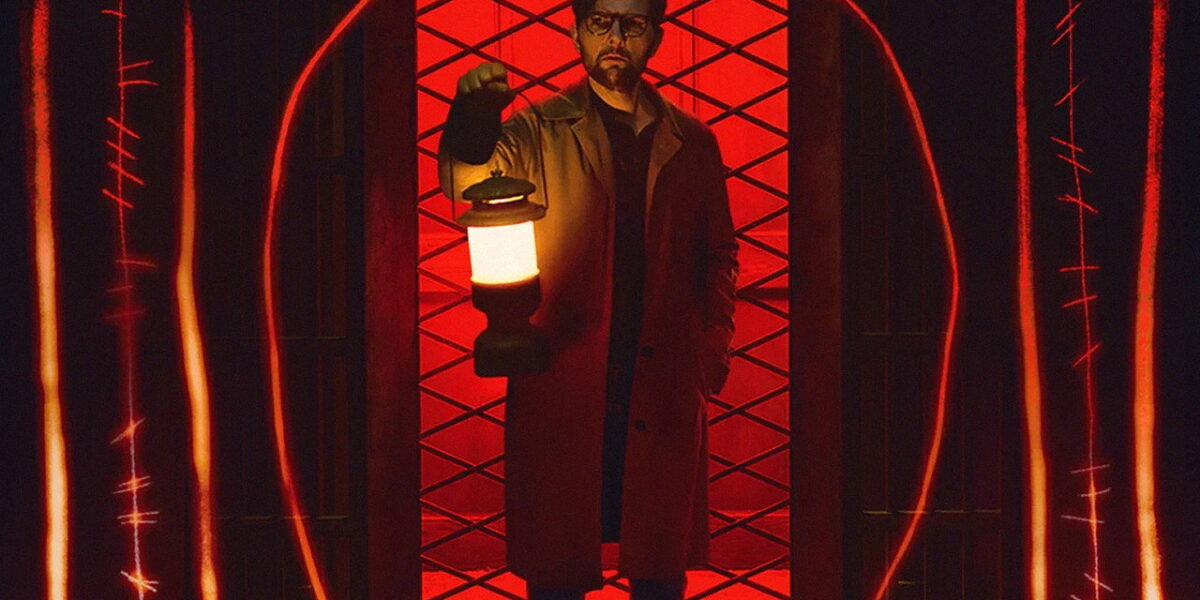
Hokum: Honest Review — Is It Worth Watching? | 7.0/10
Hokum is a genuinely unsettling psychological horror that crawls under your skin with its fog-drenched Irish setting and Adam Scott’s unraveling sanity, but it stumbles when it mistakes ambiguity for depth. The film demands patience and rewards it sporadically, though not always consistently enough to justify its deliberate pacing.
| Director | Damian McCarthy |
| Cast | Adam Scott, Peter Coonan, David Wilmot, Florence Ordesh, Will O’Connell |
| Runtime | 108 min |
| Genre | Horror, Psychological thriller |
| Year | 2026 |
The plot (no spoilers)
Hokum follows novelist Ohm Bauman as he isolates himself in a remote Irish inn to scatter his parents’ ashes—a task that quickly becomes secondary to the building dread surrounding the honeymoon suite and its storied witch. The setup feels almost quaint until McCarthy twists it into something genuinely disorienting, where reality fractures and Bauman’s grip on sanity becomes the real haunting.
The film doesn’t rush to answers, which is refreshing in an era of exposition-heavy horror, but the vagueness can also feel like stalling for time. McCarthy wants you to sit in the uncomfortable silence, to let the fog seep into your bones alongside the protagonist’s mounting paranoia, and whether that patience pays off depends entirely on your tolerance for slow-burn dread without clear payoffs.
Acting & direction
Adam Scott carries the entire picture on his increasingly haggard shoulders, and he’s excellent at conveying a man unspooling from within—there’s something almost pitiful about watching his carefully composed novelist dissolve into suspicion and fear. Peter Coonan and David Wilmot as the inn’s staff provide an unsettling undertone of menace that’s never quite explained, which works brilliantly when the script lets them breathe.
McCarthy’s direction is patient to the point of obsession—every fog-wrapped corridor feels like a maze designed specifically to disorient, and his use of sound design (or the absence of it) creates genuine unease that transcends typical jump-scare territory. The cinematography bathes everything in grey-green misery, though occasionally the self-conscious artistry overwhelms the actual horror, making scenes feel more like gallery installations than visceral frights.
The strengths
- The atmosphere is suffocating and real—McCarthy creates a sense of wrongness that doesn’t rely on cheap effects or manufactured jolts.
- Adam Scott’s performance is one of his most vulnerable and committed, showing a man cracking under psychological pressure in deeply uncomfortable ways.
- The film refuses to hold your hand or spoon-feed explanations, trusting the audience to sit with ambiguity and interpret the nightmare logic themselves.
- The Irish setting becomes almost a character itself, using landscape and isolation as weapons against the protagonist in ways that feel distinctly rooted to place.
The weaknesses
- At 108 minutes, the film stretches its central premise past breaking point, with entire sequences that feel like repetition rather than escalation.
- The final third loses its narrative thread almost entirely, pivoting toward metaphysical abstraction that never quite justifies the groundwork laid in the first hour.
- Several supporting characters feel underwritten, existing mainly to whisper cryptic warnings rather than function as actual human presences.
- The witch mythology feels half-baked, never developing into something cohesive or truly frightening, instead remaining a vague threat lurking in exposition.
Who should watch it
If you’re the type who worships Ari Aster, Robert Eggers, or even The Lighthouse-era atmospheric horror, then you’ll likely find the film’s deliberate pacing and refusal of clarity deeply satisfying. This isn’t for casual horror viewers seeking scares or genre entertainment—it’s for the arthouse horror crowd that treats discomfort as an aesthetic experience, and even then, only if you’re willing to meet McCarthy’s demands halfway.
Final verdict
The film is a fascinating failure that’s more interesting than it is entertaining, which sounds pretentious until you’re actually watching it and genuinely unsettled by its commitment to dread. Hokum has real merit in its technical execution and Scott’s anchoring performance, but it disappears up its own atmosphere in the final act, abandoning coherence for artfulness without earning that exchange. It’s worth experiencing if you have the patience for slow horror that doesn’t guarantee a payoff, but don’t expect transcendence—just a very well-crafted exercise in sustained unease that occasionally forgets why it was unsettling in the first place.
FAQ
Is Hokum a remake or based on a book?
No, Hokum is an original screenplay by Damian McCarthy. It’s not adapted from any existing source material or a remake of a previous film.
Does Hokum have jump scares?
Minimal jump scares—McCarthy focuses on psychological dread and atmospheric tension rather than sudden shocks, making it much more unsettling than traditionally frightening.
Is Adam Scott’s character really haunted or is it all in his head?
McCarthy deliberately leaves this ambiguous throughout, blurring the line between supernatural haunting and mental breakdown without giving a definitive answer.
How does Hokum compare to other Damian McCarthy films?
This is McCarthy’s most ambitious work yet, scaling up his signature fog-drenched atmosphere and unreliable perspective to feature length with mixed but intriguing results.
Will Hokum get a wider theatrical release?
As of now, distribution details remain limited, but the film’s festival circulation and growing word-of-mouth suggest theatrical expansion is likely in certain markets.