Howl’s Moving Castle: Ending Explained — Ultimate Breakdown
Few animated films dare to embed an entire philosophy of selfhood inside a love story, but Howl’s Moving Castle does exactly that. Hayao Miyazaki’s 2004 masterpiece is not merely a fairy tale about curses and wizards — it is a meditation on identity, war, and the radical act of choosing to live. The ending, in particular, rewards those willing to look beneath its enchanting surface and confront what Miyazaki is truly saying about the human soul.
Howl’s Moving Castle: What happens at the end
In the film’s climax, Sophie races against time to save Howl, whose repeated use of dark magic has pushed him dangerously close to an irreversible transformation into a monstrous bird-creature. The war raging around the moving castle reaches a fever pitch, with bombs destroying the kingdom’s cities. Sophie descends into Calcifer‘s magical fire, discovering that the flame-demon holds Howl‘s heart — a literal, pulsing organ he surrendered long ago in exchange for power.
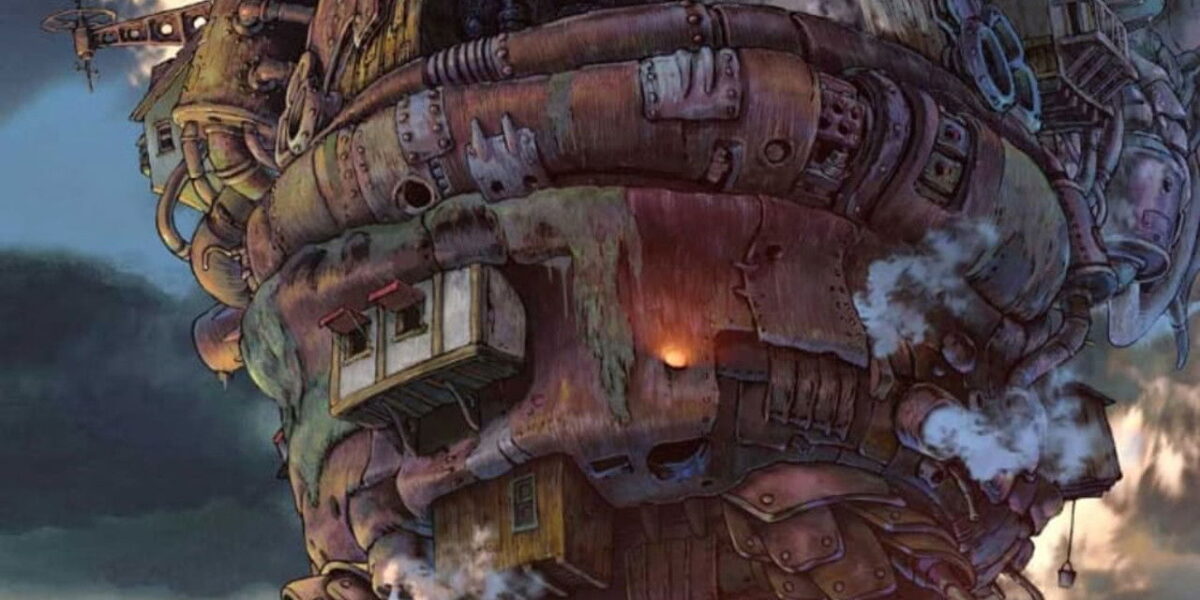
In a breathtaking sequence, Sophie travels back through time, witnessing the moment a young Howl first gave his heart to Calcifer. She calls out to him across time, declaring her love and promising to return. Back in the present, she frees Calcifer by returning Howl‘s heart to his chest. The castle crumbles, the Witch of the Waste — now reformed — cradles the heart protectively. Sophie‘s curse finally breaks completely, and the two are reunited in the sky aboard a living, breathing remnant of their home.
The deeper meaning
The curse placed on Sophie is one of cinema’s great metaphors for internalized shame. At the story’s opening, she already speaks of herself as plain, unimportant, destined for obscurity. The Witch of the Waste did not invent her old age — she simply made visible what Sophie already believed about herself. The ending’s reversal is therefore not magical restoration but psychological liberation: Sophie accepts her own worth, and the body finally reflects what the spirit has become.
Miyazaki, speaking through the film’s anti-war imagery, insists that love is not passive sentiment — it is an act of resistance. Howl‘s surrendered heart is the director’s metaphor for the emotional detachment that power demands. Governments, like the wizards conscripted into combat, require their servants to become heartless. The restoration of Howl‘s heart is Miyazaki’s defiant declaration that humanity must reclaim its capacity for feeling, even — and especially — in the middle of destruction.
Hidden details & easter eggs
Throughout the film, Sophie‘s hair remains silver-gray even during moments when the curse visibly lifts — a subtle visual cue that Miyazaki plants deliberately. Her hair does not return to its original auburn because her transformation is never meant to be a full reversal. She carries her experience as an old woman forward, a permanent mark of wisdom gained. Sharp-eyed viewers will also notice that the moving castle’s door, which connects to multiple locations, mirrors Sophie‘s own fluid, shifting sense of self across the narrative.
Connections to the rest of the film
The film’s opening scene contains exquisite foreshadowing: when Howl catches Sophie as she falls from a balcony, they float briefly through the air together — an image that directly echoes the final reunion above the clouds. Miyazaki uses foreshadowing not as a puzzle to be solved but as a motif of emotional inevitability. The audience feels the ending has always been approaching, not because destiny ordained it, but because these two characters have been teaching each other to stay present throughout every scene.
Fan theories
One compelling theory argues that Sophie‘s curse was never truly the Witch of the Waste‘s doing — that Sophie‘s own self-loathing manifested the transformation, which is why it fluctuates with her confidence. Evidence: the curse weakens visibly whenever Sophie acts with purpose or anger. Against: the film presents the Witch as a genuine antagonist with tangible power. A second theory suggests Calcifer is a metaphor for Howl’s creative and artistic soul rather than his emotional heart, given the fire’s role in sustaining beauty and imagination inside the castle. You can explore further context on IMDB.
FAQ
Why does Sophie’s hair stay gray at the end of the film?
Her silver hair remains because the curse’s full reversal was never the point — Sophie has genuinely aged through experience and wisdom, and Miyazaki preserves that transformation as a mark of growth rather than erasing it entirely.
Does Howl truly love Sophie, or was he drawn to her because of the curse?
Howl is drawn to Sophie‘s spirit and courage, qualities present long before the curse. The film suggests their bond is built through shared vulnerability, not magical compulsion.
What does Calcifer represent in the ending?
Calcifer represents the fragment of humanity Howl surrendered to gain power — freeing him means Howl chooses feeling over invulnerability, which is the film’s central emotional argument.
Is the ending faithful to Diana Wynne Jones’s original novel?
Miyazaki departs significantly from the source novel, adding an anti-war dimension and restructuring the emotional resolution so that Sophie‘s internal journey becomes the narrative’s true engine.
What does the flying ending image symbolize?
The final image of Sophie and Howl airborne together symbolizes freedom from both the curse and the war — they exist, momentarily, outside every system that sought to diminish or weaponize them.