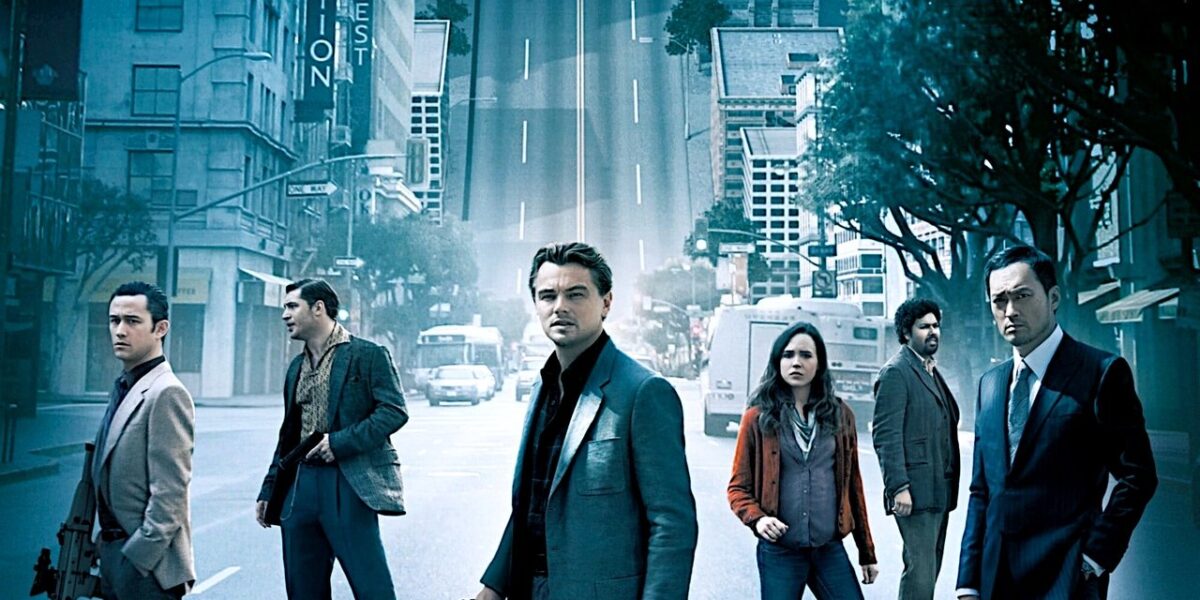
Inception: Ending Explained — Ultimate Breakdown
Few films have ignited as much debate as Inception, Christopher Nolan’s labyrinthine masterpiece of dream architecture and buried grief. The final shot — a spinning top, a cut to black — has haunted audiences since 2010, transforming a blockbuster into a philosophical puzzle box. What separates great cinema from mere entertainment is precisely this: the ability to plant a question so deep inside the viewer’s mind that it never stops spinning. This is exactly what Nolan engineered.
Inception: What happens at the end
Dom Cobb and his team successfully perform inception on Robert Fischer, planting the idea to dissolve his father’s empire. After surviving multiple dream layers and a harrowing descent into Limbo, Cobb finally returns to reality. Cleared of the murder charges that kept him from his children, he lands in the United States and rushes home. His father-in-law, Professor Miles, has brought his kids back. The reunion is emotionally overwhelming — the moment Cobb has fought for across the entire film finally arrives.
Before fully embracing his children, Cobb spins his totem — the small top that distinguishes dream from reality. He then walks toward his kids, and the camera lingers on the spinning top. It wobbles — ever so slightly — but the screen cuts to black before it falls or continues indefinitely. That wobble is everything. It is not an accident. It is a deliberate, devastating withholding of certainty, and it is arguably the most consequential edit in modern cinema.
The deeper meaning
The spinning top is a metaphor for the fragility of perceived reality itself. But there is a deeper layer: the totem originally belonged to Mal, Cobb‘s deceased wife. He adopted it after her death. This matters enormously — because a totem only works as a reality anchor if no one else knows its properties. Since Mal knew it intimately, the top was already a compromised instrument. Nolan embeds this detail quietly, suggesting that Cobb‘s entire method of distinguishing dream from reality may be fundamentally flawed.
Nolan’s intention transcends the binary question of real-or-dream. The film argues that Cobb has chosen to stop caring about the answer. He walks away from the top before it settles. This is not weakness — it is liberation. The film’s true subject is grief, and its resolution is not logical but emotional: Cobb finally lets go of Mal‘s ghost and chooses presence over certainty. Nolan constructs the ending not as a trick but as a portrait of a man choosing to live.
Hidden details & easter eggs
One of the film’s most rewarding hidden details involves the children’s faces. Throughout the film, every memory of Cobb‘s children shows them from behind, frozen in the same pose. In the final scene, they turn around — their faces fully visible for the first time. This visual shift functions as a quiet but thunderous signal: something has changed. Whether it confirms reality or suggests a perfectly constructed dream is deliberately ambiguous. Additionally, the children appear to be wearing the same clothes as in Cobb‘s memories, a detail hardcore fans point to obsessively. You can explore full cast and production details on IMDB.
Connections to the rest of the film
Nolan plants the seeds of the ending with extraordinary precision. The recurring motif of Cobb never looking at his children’s faces in flashbacks is a form of foreshadowing so subtle it registers only in retrospect. Similarly, Mal‘s accusation that Cobb can no longer distinguish dream from reality echoes forward into the final scene with unbearable irony. Ariadne‘s role as the architect who literally reconstructs Cobb‘s subconscious mirrors the audience’s own position — both of them trying to map a mind that refuses to be fully known.
Fan theories
The dominant theory holds that the entire film is a dream — that Cobb never woke up after being stranded in Limbo with Mal. Evidence includes the top’s suspicious behavior and the children’s unchanged appearance. Against this: Cobb‘s wedding ring, which he wears only in dream sequences and never in the real world, is absent in the final scene. A second theory proposes the film is entirely Cobb‘s own inception — that Miles orchestrated the mission to plant the idea of returning home inside Cobb‘s own mind. Both readings are textually supportable, which is precisely Nolan’s genius.
FAQ
Does the top fall at the end of Inception?
The film cuts to black before the top settles. It visibly wobbles — suggesting it may be about to fall — but Nolan deliberately withholds the answer, leaving the reality of the final scene permanently ambiguous.
Is Cobb still in a dream at the end?
The film never confirms this definitively. The absence of Cobb‘s wedding ring in the final scene — which he wears only in dreams throughout the film — is the strongest visual argument that he has returned to reality.
Why does Cobb use Mal’s totem?
Cobb took Mal‘s spinning top after her death as a way to maintain a connection to her. However, because she knew the totem’s properties, it is technically an unreliable anchor — a flaw the film quietly acknowledges.
What does the ending of Inception really mean thematically?
Thematically, the ending represents Cobb‘s choice to embrace life over certainty. He stops watching the top before it falls — signaling that he has finally let go of his obsession with Mal and chosen presence with his children.
Were Cobb’s children the same age in the final scene?
Yes — and this is intentional. The children appear in the same clothes and at the same age as in Cobb‘s memories, which fans interpret as either a sign he is dreaming or a deliberate emotional echo constructed by Nolan.
“`