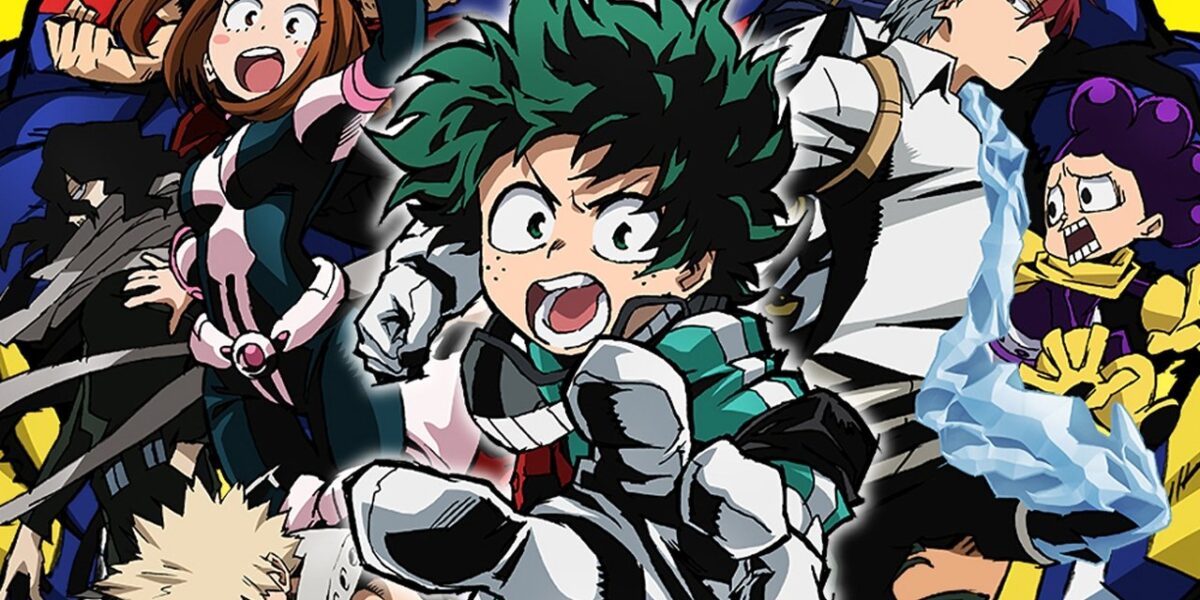
My Hero Academia: Ending Explained — Ultimate Breakdown
My Hero Academia is not simply a story about superpowers — it is a meditation on inherited legacy, the crushing weight of expectation, and the radical act of choosing who you want to become. Across eight seasons, this landmark anime has built one of the most emotionally sophisticated narrative architectures in contemporary animation. Here, we dissect what its culminating arcs truly say about heroism, sacrifice, and the meaning of a world that demands perfection from its saviors.
My Hero Academia: What happens at the end
The final confrontation brings Izuku Midoriya — voiced with aching sincerity by Daiki Yamashita — face to face with Tomura Shigaraki, the embodiment of everything society has abandoned and left to rot. The battle transcends physical combat entirely. It becomes a psychological excavation, as Izuku reaches into Shigaraki‘s fractured consciousness to find not a monster, but a devastated child named Tenko Shimura, still screaming for help inside a shell built from decades of neglect and manipulation.
Rather than destroying his enemy, Izuku extends his hand — an act so simple it feels almost naive, yet carries the full gravitational weight of everything the series has constructed. All For One‘s grip on Shigaraki is ultimately severed not through overwhelming force but through empathy so fierce it functions as its own superpower. The One For All quirk, passed across generations, finally expends its last embers, leaving Izuku powerless yet spiritually transformed — a hero defined not by ability but by an unbreakable will to reach for others.
The deeper meaning
The central metaphor operating throughout the series crystallizes here with devastating clarity: One For All is not a weapon — it is accumulated human love, passed from hand to hand like a torch across generations. When Izuku surrenders it, he does not lose himself. He fulfills the quirk’s deepest purpose, which was never about power but about connection. The series argues, with genuine conviction, that heroism without empathy is merely violence wearing a costume, and that true strength lives in the willingness to be vulnerable.
The creative vision behind the series, rooted in Kōhei Horikoshi‘s original manga, positions Shigaraki‘s redemption arc as a structural mirror to Izuku‘s origin. Both began as powerless boys dismissed by a society obsessed with measurable ability. The difference was not destiny but the presence or absence of a single person who chose to see them. This is the series’ most radical thesis: systemic cruelty creates its own villains, and heroism means dismantling that system from within, one act of recognition at a time.
Hidden details & easter eggs
Attentive viewers will notice that the hand Izuku extends toward Tenko in the final confrontation mirrors — almost frame for frame — the gesture All Might made when he first acknowledged Izuku‘s worth in season one. This visual callback is not accidental. It is a foreshadowing loop closing upon itself, confirming that the series’ entire architecture was constructed around a single repeating truth: being truly seen by another person is the most transformative force in any universe, with or without superpowers.
Connections to the rest of the series
The foreshadowing embedded across earlier seasons rewards obsessive rewatching. All Might‘s famous declaration — “I am here” — functions throughout as both reassurance and promise. In the finale, it is Izuku who embodies that phrase, arriving not with power but with presence. Meanwhile, the recurring visual motif of broken walls — from Izuku‘s crumbling bones to Shigaraki‘s disintegration quirk — finds its ultimate resolution in the idea that destruction and creation are inseparable forces in the making of any new world.
Fan theories
Several compelling theories circulate among the series’ passionate community. The first holds that Izuku will eventually regain a fragment of One For All, preserved within Eri‘s rewind quirk — a reading supported by careful foreshadowing of her growing power but complicated by the thematic cost it would impose on his sacrifice. A second theory argues that Shigaraki‘s survival represents a deliberate narrative open wound, suggesting the series intends a future where a reformed Tenko becomes a different kind of hero — evidence for this lives in his final, childlike expression. You can explore broader reception on IMDB.
FAQ
Does Izuku lose his powers permanently at the end?
Izuku Midoriya exhausts One For All completely in the final battle, leaving him without the quirk. However, some fan interpretations and story threads involving Eri‘s ability leave the door marginally open for a partial restoration.
Is Shigaraki redeemed or destroyed at the end?
The series presents a layered resolution — the villainous persona of Shigaraki is dismantled, but the inner child Tenko Shimura is reached and acknowledged. Whether this constitutes redemption or simply recognition is deliberately left for the audience to decide.
What does One For All represent thematically?
One For All functions as a metaphor for generational inheritance — the idea that love, sacrifice, and purpose can be passed forward through time, accumulating meaning with every bearer who chooses to carry them responsibly.
Why is All Might so important to the ending’s meaning?
All Might represents the old model of heroism — singular, spectacular, unsustainable. The ending reframes his legacy by showing that his greatest contribution was not his power but his belief in Izuku, which multiplied outward into an entirely new vision of what a hero can be.
What is the core message of the series’ conclusion?
The series concludes that heroism is not a biological gift or a measure of raw power but an ethical choice made repeatedly under pressure — and that even a world designed to produce suffering can be redirected by individuals who refuse to stop reaching for others.