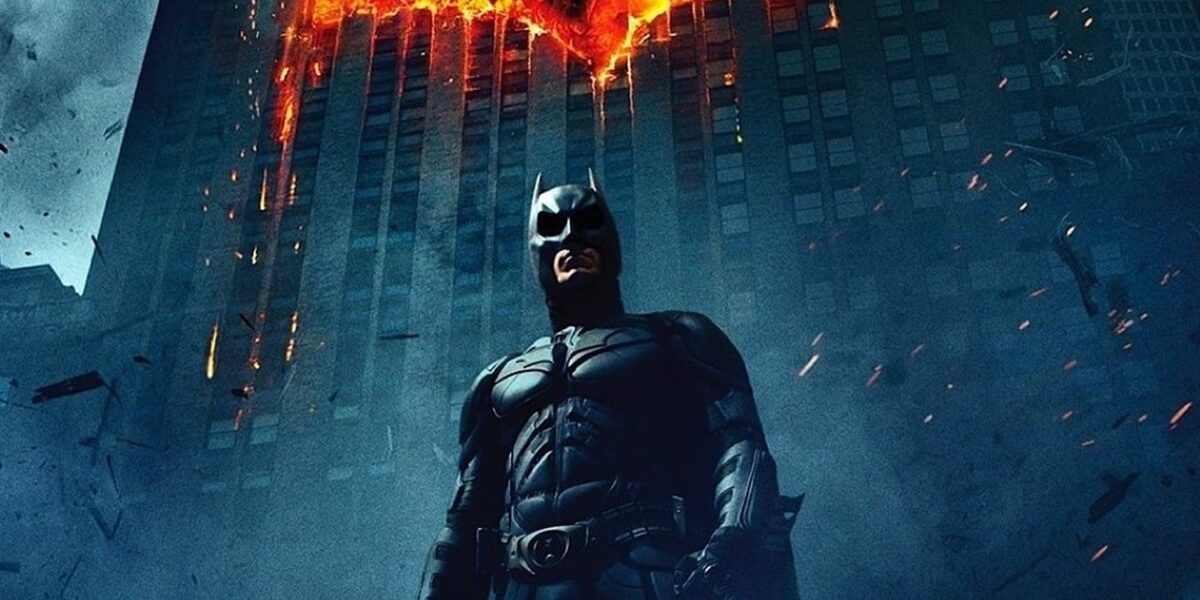
The Dark Knight: Ending Explained — Ultimate Breakdown
Few endings in superhero cinema cut as deep as the one Christopher Nolan delivers in The Dark Knight. What appears to be a conventional hero’s sacrifice conceals one of the most morally devastating arguments ever committed to film. This analysis tears apart the final act — its symbols, its lies, and its brutal honesty about what it truly costs to protect a city that may not deserve protecting.
The Dark Knight: What happens at the end
Harvey Dent, once Gotham’s shining White Knight, has become Two-Face — a grief-maddened killer dispensing brutal coin-flip justice after the death of Rachel Dawes. He kidnaps Commissioner Gordon‘s family and holds them at gunpoint. Batman arrives, confronts him, and ultimately tackles Two-Face off a ledge to save Gordon’s son. Both Batman and Dent fall. Dent dies. Batman survives, broken but breathing, staring at the wreckage of everything the alliance was supposed to build.
In the aftermath, Commissioner Gordon and Batman make a calculated, devastating decision: they will bury the truth about Harvey Dent’s crimes. Gotham will believe its hero died pure. Batman accepts full blame for Dent’s murders, becoming the city’s villain so that its people can keep their hope. Gordon destroys the Bat-Signal as Alfred watches Bruce Wayne ride into the darkness — not triumphant, but exiled by a lie he chose to carry alone.
The deeper meaning
The ending is a ferocious meditation on the necessary lie as a pillar of civilization. Nolan argues — uncomfortably — that societies sometimes cannot survive their own unfiltered truth. The Joker spent the entire film insisting that human beings are one bad day away from savagery. Batman’s final act is designed to prove him wrong, but the method of disproving him is itself a kind of surrender: Gotham’s moral order must rest on a fabrication. The hero wins by becoming the monster the story needed.
Nolan‘s intention is unmistakably political. Released in 2008, during an era defined by surveillance, moral compromise, and the rhetoric of security at any cost, the film forces its audience to sit inside the discomfort of an impure victory. Bruce Wayne does not ride off into a sunset — he rides into a darkness that is partly of his own making. The noble lie, borrowed from Plato, is presented not as heroism but as tragedy dressed in heroic clothing, demanding the audience interrogate their own appetite for comforting myths.
Hidden details & easter eggs
Watch Gordon‘s voiceover during the final chase sequence — his words describing Batman as “the hero Gotham deserves, but not the one it needs right now” function as a direct inversion of the film’s earlier moral logic, where Dent was positioned as the deserved hero. The coin Two-Face flips is always his scarred side facing up when he decides to kill, a detail Nolan hides in plain sight — suggesting fate was never random, only the performance of randomness. You can find full production details on IMDB.
Connections to the rest of the film
The ending’s power is inseparable from a masterful thread of foreshadowing woven from the opening frame. Early in the film, Alfred tells the story of the bandit who burned the forest — “some men just want to watch the world burn.” This metaphor returns with devastating weight at the end: Batman does not burn the world, but he scorches his own identity to preserve it. Similarly, Harvey Dent‘s line — “You either die a hero or live long enough to see yourself become the villain” — is the film’s secret thesis, delivered by the man who proves it most tragically.
Fan theories
One persistent theory holds that Batman intentionally lets Two-Face die rather than sacrificing himself to save him, reading Bruce’s fall as a calculated elimination of a loose end. The evidence — Batman’s tactical precision throughout the film — is compelling but ultimately undermined by Nolan‘s visual language, which codes the moment as desperate rather than deliberate. A second theory suggests the Joker actually won: by forcing Batman into a lie, he corrupted Gotham’s foundations more profoundly than any bomb ever could. This reading is the most intellectually satisfying, and the one the film’s final image quietly endorses.
FAQ
Why does Batman take the blame for Harvey Dent’s murders?
Batman takes the blame to preserve Dent’s heroic image, which forms the legal and moral foundation of Gotham’s anti-crime legislation. If Dent’s crimes became public, every conviction secured under the Dent Act would collapse, releasing hundreds of criminals back onto the streets.
Does the Joker win at the end of the film?
Philosophically, a strong argument exists that the Joker wins. He predicted that one bad day would break any person’s morality, and Harvey Dent’s transformation proves him right. Batman’s lie further confirms that Gotham’s order depends on deception rather than genuine virtue.
Is Harvey Dent’s coin rigged?
Yes — both sides of Two-Face’s coin are identical. The scarred side is always facing up during kill decisions, revealing that his “random” justice is unconsciously predetermined, making his descent into madness even more tragic than it first appears.
What does Batman’s exile symbolize at the end?
Batman’s exile symbolizes the cost of moral compromise. By accepting the role of villain, Bruce Wayne loses the one thing that separated him from the criminals he fights: public legitimacy. He becomes a guardian operating entirely outside the social contract he sacrificed everything to defend.
Will Batman ever be exonerated in the story’s world?
In The Dark Knight Rises, the truth about Harvey Dent is eventually revealed by Bane, dismantling the Dent Act and vindicating Batman’s reputation posthumously — though by then, the lie has already shaped an entire decade of Gotham’s history.
“`