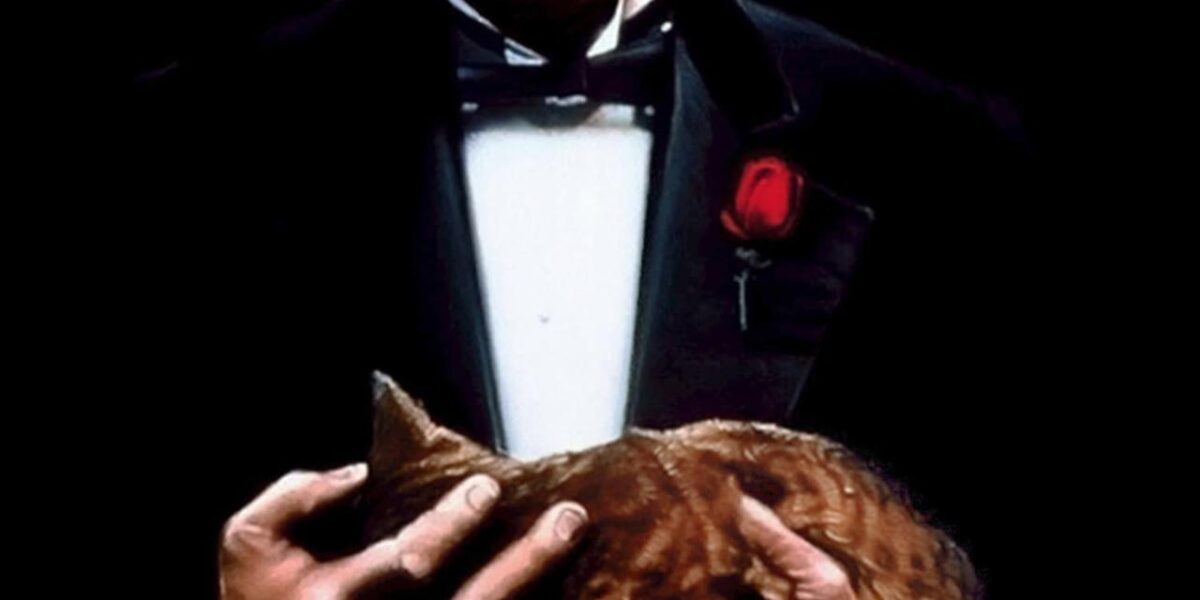
The Godfather: Ending Explained — Ultimate Breakdown
Few endings in cinema history carry the weight of The Godfather. Francis Ford Coppola’s 1972 masterpiece closes not with a bang, but with a door — a single, deliberate movement that seals the fate of every character and idea the film has so carefully constructed. What appears to be a conclusion is, in truth, a beginning: the birth of a monster dressed in the skin of a man we once loved.
The Godfather: What happens at the end
In the film’s final sequence, Michael Corleone orchestrates the simultaneous assassination of the heads of the Five Families, along with Moe Greene and the traitors within his own circle. Each killing is intercut with the baptism of Connie‘s baby, where Michael stands as godfather. He solemnly renounces Satan before the altar while his men execute his enemies across the city. The juxtaposition is not accidental — it is the film’s moral thesis delivered in its most visceral form.
Afterward, Michael confronts his brother-in-law Carlo Rizzi, who confessed to setting up Sonny Corleone‘s murder. Carlo is strangled in his car despite being promised safe passage. When Kay Adams asks Michael directly whether he ordered Carlo‘s death, he denies it — and she chooses to believe him. The film ends as Michael‘s capos kiss his hand and address him as “Don Corleone,” while Kay watches from the doorway before it slowly, definitively closes in her face.
The deeper meaning
The closing door is one of cinema’s most devastating metaphors. It does not simply shut Kay out — it shuts out innocence, truth, and the possibility of redemption. Michael has fully crossed the threshold into his father’s world, a world that operates on loyalty, power, and the systematic erasure of conscience. The door is also a boundary between two realities: the domestic and the criminal, the visible and the hidden, the lie and the truth that can never be spoken aloud.
Coppola’s intention was to craft a tragedy of corruption that feels inevitable rather than sudden. Every choice Michael makes appears rational, even noble — protecting his father, defending his family, eliminating chaos. Yet Coppola frames each decision as a quiet surrender of the soul. The film is not a glorification of organized crime; it is a portrait of how power hollows out a man from the inside, leaving only the perfect, terrifying shell of authority.
Hidden details & easter eggs
Throughout the baptism sequence, Coppola employs precise visual symbolism that rewards close attention. The priest’s liturgical Latin — “Do you renounce Satan?” — is heard as a gunshot fires onscreen, creating a direct audio-visual equation between religious ritual and murder. Notice also that Michael never flinches during the ceremony; his face is a mask of absolute composure. Gordon Willis‘s cinematography keeps him in shadow even in a brightly lit church, signaling that darkness has already claimed him entirely and irrevocably.
Connections to the rest of the film
The ending echoes the film’s opening in a deeply satisfying act of foreshadowing. In the first scene, Vito Corleone sits in shadow dispensing justice on the day of his daughter’s wedding — power exercised quietly while celebration rages outside. By the final scene, Michael occupies that exact same position, both literally and spiritually. The film has traveled a complete arc, replacing one patriarch with another, suggesting that the Corleone dynasty is not a story of individuals but of an inescapable, self-perpetuating institution.
Fan theories
One compelling theory argues that Kay already knows the truth when she asks Michael about Carlo‘s death — and that she chooses complicity over confrontation, making her morally implicated in the very corruption she fears. A counterpoint theory suggests the opposite: that her choice to believe the lie represents genuine self-deception, a survival mechanism. A third reading frames the entire ending as Michael‘s own tragedy — that he genuinely believes he is protecting his family, making him not a villain but a man destroyed by love distorted into control. All three readings find compelling evidence in Al Pacino‘s extraordinarily opaque performance throughout the film.
FAQ
Why does the door close on Kay at the end of The Godfather?
The closing door symbolizes Kay‘s permanent exclusion from Michael‘s true world. She is now the wife of a Don, kept safe and kept ignorant — the door marks the definitive boundary between her domestic reality and the criminal empire she will never be allowed to fully see or understand.
Does Michael actually love Kay, or is she just a symbol of legitimacy?
Michael‘s feelings for Kay are real but ultimately subordinate to his need for control. She represents the legitimate, American life he once wanted — but by the film’s end, she functions primarily as a domestic facade that conceals the true nature of his power and insulates him from outside scrutiny.
Why is the baptism intercut with the murders?
Coppola uses parallel editing to create a direct metaphor: as Michael verbally renounces evil in the church, he simultaneously enacts it across the city. The sequence exposes the fundamental hypocrisy at the heart of the Corleone worldview — the belief that family and faith can coexist with systematic violence and murder.
Was Carlo’s death necessary from Michael’s perspective?
From Michael‘s strategic viewpoint, Carlo Rizzi‘s death was an absolute necessity. Carlo had betrayed the family by setting up Sonny‘s assassination, making him an irreparable liability regardless of any promise of safe passage. The killing also demonstrates that Michael‘s mercy is always conditional and that family loyalty is the only currency with real value in his world.
What does the title “Don Corleone” mean when applied to Michael at the end?
When the capos address Michael as “Don Corleone,” it confirms the complete transfer of dynastic power. The title carries enormous weight because it was previously associated exclusively with Vito‘s wisdom and restraint — applying it to Michael signals that an era of calculated, cold authority has replaced the older patriarch’s more human, if equally ruthless, brand of leadership. You can explore more about the film on IMDB.