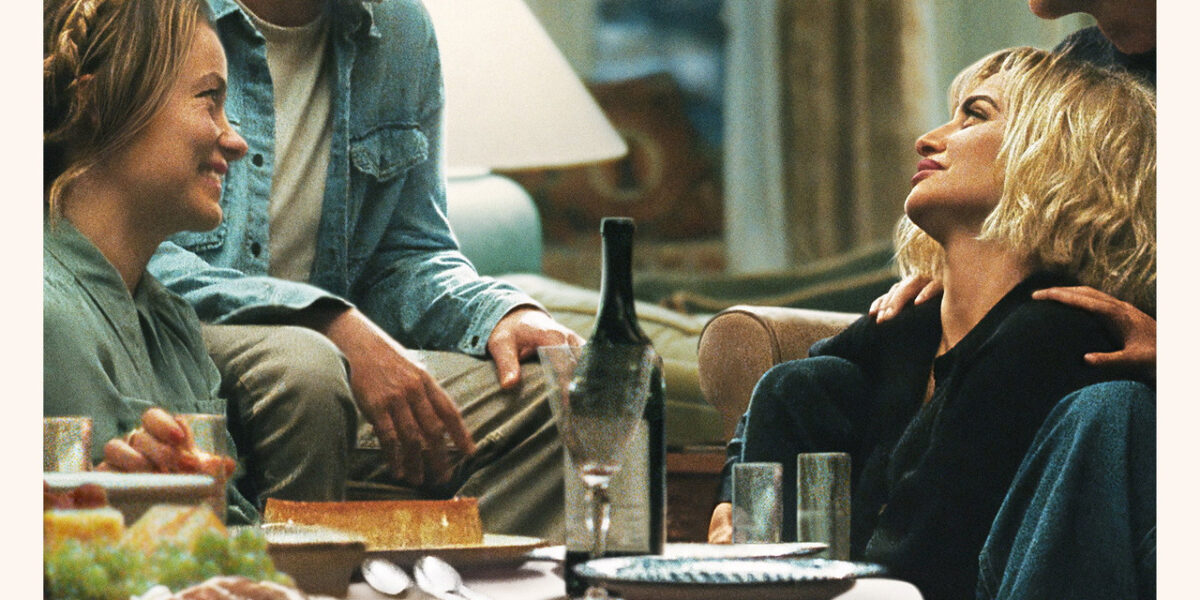
The Invite: Ending Explained — Ultimate Breakdown
Few films dare to use a dinner party as a controlled detonation device for an entire marriage, but The Invite does exactly that with surgical wit and emotional ferocity. Directed by Olivia Wilde, this 2026 drama-comedy-romance starring Seth Rogen and Wilde herself alongside the magnetic Penélope Cruz and Edward Norton constructs a pressure cooker of desire, resentment, and rebirth — then lets it explode in a finale that demands to be unpacked frame by frame.
The Invite: What happens at the end
As the dinner party reaches its breaking point, Joe (Seth Rogen) and Angela (Olivia Wilde) find themselves stripped of every social mask they have worn throughout the evening. The neighbors — Marco (Edward Norton) and Lucia (Penélope Cruz) — have functioned all night as living mirrors, reflecting back the couple’s buried truths with uncomfortable precision. In the final act, a devastating confrontation erupts not between the couples but between Joe and Angela themselves, raw and unscripted in a way their marriage has not been for years.
The film’s closing image is deceptively quiet: Joe and Angela stand at their kitchen window as dawn breaks, the dinner table still wrecked behind them. They do not reconcile in any conventional sense, nor do they separate. Instead, Angela reaches for Joe‘s hand — and he hesitates before taking it. That hesitation is the entire film compressed into a single gesture, carrying the full weight of everything confessed, broken, and tentatively rebuilt across the preceding one hundred and seven minutes.
The deeper meaning
The ending operates as a masterclass in ambiguity as emotional honesty. Wilde‘s refusal to offer clean resolution is itself the message: intimacy is not a problem that gets solved, but a condition that must be continuously chosen. The metaphor of the dinner — an act of invitation, of opening one’s home and therefore one’s vulnerability — becomes the film’s central argument. To invite someone in, whether a neighbor or a feeling long suppressed, is always to risk transformation you cannot control.
Wilde as director appears deeply interested in what happens when comfort calcifies into complacency. Marco and Lucia are not catalysts by accident — they represent the road not taken, the version of passion that Joe and Angela have quietly mourned. By introducing this foil couple into the domestic space, the film forces its protagonists to grieve what their relationship has lost, which is the necessary first step toward honestly rebuilding it on new, less deluded foundations.
Hidden details & easter eggs
Attentive viewers will notice that every wine glass on the table corresponds to a specific emotional beat: full glasses mark moments of performance, empty ones signal genuine confession. Wilde and cinematographer Skip Howland compose the frame so that Angela is almost always positioned near doorways — thresholds, symbolically — underscoring her perpetual state of almost-leaving throughout the narrative. The playlist Angela curates for the party contains songs exclusively from the year she and Joe met, a quietly devastating detail that surfaces only if you know to listen for it.
Connections to the rest of the film
The ending’s power is inseparable from a critical piece of foreshadowing planted in the film’s opening scene, where Angela rehearses what she will say to the neighbors before knocking on their door — practicing intimacy rather than feeling it. This motif of rehearsed versus spontaneous emotion threads through every scene, making the finale’s unscripted hand-hold genuinely earned. Even the tagline, It’ll be fun, recontextualizes itself by the final frame as the kind of breezy lie couples tell themselves to avoid confronting what a shared evening might actually cost them.
Fan theories
One compelling theory argues that Marco and Lucia are not real neighbors at all but psychological projections — manifestations of the desires Joe and Angela have suppressed so long they required external form. The evidence is suggestive: the neighbors leave no physical trace of the evening, and no other character ever independently confirms seeing them. Against this reading, however, the film’s comedic realism and grounded performances by Norton and Cruz resist pure allegory. A second theory holds that Angela orchestrated the entire evening deliberately, having already decided to leave Joe and using the party as a farewell ritual she could not otherwise articulate. You can find more community discussion around the film on IMDB.
FAQ
Does Joe and Angela’s marriage survive at the end of the film?
The ending deliberately refuses a definitive answer. Joe‘s hesitation before taking Angela‘s hand signals the marriage survives, but in a fundamentally altered and more honest form — not a happy ending so much as an honest new beginning.
What do Marco and Lucia represent thematically?
Marco and Lucia function as a foil couple, embodying the passionate, uncalculated intimacy that Joe and Angela have lost. Their presence forces the protagonists to confront their own emotional numbness rather than simply observe someone else’s vitality.
Why does Angela always stand near doorways throughout the film?
It is a deliberate visual motif by Olivia Wilde signaling Angela‘s psychological ambivalence — she is perpetually positioned between staying and leaving, making her final choice to reach for Joe‘s hand all the more meaningful and hard-won.
Is the theory that Marco and Lucia are imaginary supported by the film?
The theory has intriguing circumstantial support — their lack of physical traces and symbolic function — but the film’s grounded comedic tone and the fully realized performances of Norton and Cruz make a purely supernatural or psychological reading difficult to sustain with certainty.
What does the tagline “It’ll be fun” mean in context of the ending?
By the final scene, the tagline reads as devastating irony: it is the kind of casually optimistic phrase couples use to avoid naming what they actually fear. The film reveals that the evening was never going to be simply fun — it was always going to be reckoning.