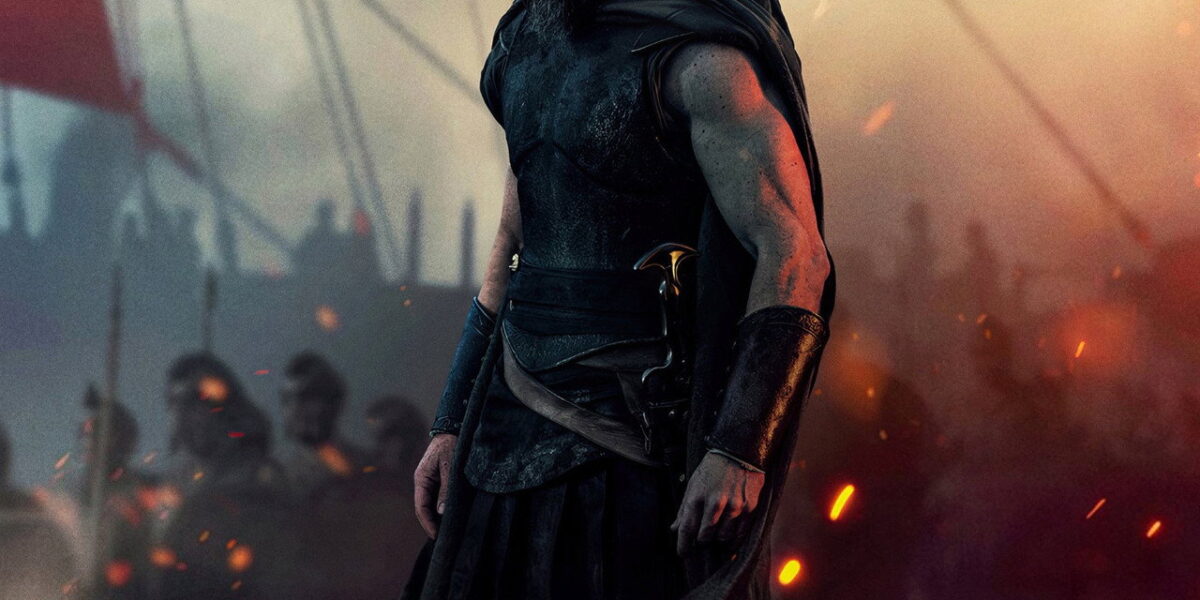
The Odyssey: Honest Review — Is It Worth Watching? | 5.2/10
The Odyssey is a bloated, technically impressive misfire that confuses spectacle for substance and forgets why Homer’s tale still matters after three thousand years. Christopher Nolan’s 2026 adaptation sinks under the weight of its own ambition, drowning in mythology when it should be drowning us in humanity.
| Director | Christopher Nolan |
| Cast | Matt Damon, Tom Holland, Anne Hathaway, Robert Pattinson, Lupita Nyong’o |
| Runtime | 173 min |
| Genre | Adventure, Action, Fantasy |
| Year | 2026 |
The Odyssey: The plot (no spoilers)
The Odyssey tracks Odysseus’s journey home after Troy, and on paper, this is catnip for anyone who grew up with Homer’s epic. The film compresses ten years of wandering into what feels like ten hours of visual noise, with gods throwing tantrums and monsters appearing on cue like action-sequence checkboxes rather than organic obstacles that test the hero’s wit and will.
Nolan frames this as a meditation on hubris and redemption, but the movie never commits to either theme long enough to land any real emotional punch. The tone whiplashes between bombastic set pieces and introspective character moments that feel grafted on after the fact, as if someone told the director halfway through that audiences might actually care about who Odysseus is beyond his ability to survive CGI spectacle.
Acting & direction
Matt Damon is doing his best with a character who’s been hollowed out by the script—he’s competent but exhausted, delivering most of his lines with the resigned expression of a man stuck on a failing freighter for nearly three hours. Tom Holland shows up as Telemachus with genuine vulnerability that the film doesn’t deserve, while Anne Hathaway‘s Athena feels like she wandered in from a better movie where gods actually had personalities instead of CGI ripples and ominous whispers.
Nolan’s direction feels suffocated by his own reputation here—every frame is composed to death, every edit calculated to within an inch of its life, and somehow the whole thing moves like a glacier made of spectacle. Hans Zimmer’s score is competent orchestral wallpaper that announces emotions rather than suggesting them, and the cinematography, while technically pristine, has all the soul of a luxury car commercial filmed in the Azores.
The strengths
- The production design of Ithaca and the mythological locations has a tactile, lived-in quality that the digital monster work completely undermines.
- There are genuine moments in the second act where the film remembers it’s about a man desperate to get home, and those quiet sequences carry more weight than all the Cyclops sequences combined.
- Lupita Nyong’o as Calypso brings intelligence and melancholy to a role that could have been disposable, reminding us what this film needed more of: actors allowed to simply exist rather than react to green-screen nonsense.
The weaknesses
- At one hundred seventy-three minutes, the movie is fundamentally bloated—it has zero discipline about what to cut, padding every monster encounter with unnecessary backstory and false dramatic stakes that collapse the moment something louder happens onscreen.
- The digital effects are aggressively ugly, turning Homer’s poetic monsters into video-game bosses with the personality of wet cardboard, and the contrast between this sterile CGI and the more grounded character work creates constant tonal whiplash.
- Robert Pattinson as Hermes is so severely underutilized that you wonder why the producers bothered casting him when a voiceover artist could have handled the role with equal impact, which speaks to how scattered Nolan’s priorities became midway through production.
- The film completely botches the emotional core of the Odyssey—the yearning for home, the cost of survival, the question of whether a man can ever truly return after seeing what he’s seen—in favor of watching a middle-aged Matt Damon grimace while things explode around him.
Who should watch it
If you’re a completist Nolan devotee who’ll sit through anything he makes, or if you’re genuinely desperate for epic fantasy-adventure content regardless of quality, the film delivers on scale and craft even as it fails on substance. Fans of mythology will be disappointed by how reductively the source material has been adapted, and anyone seeking the kind of character-driven storytelling that makes Odysseys meaningful in any era should skip this and reread Homer instead.
Final verdict
The Odyssey is a monument to what happens when a brilliant director gets lost in his own process and forgets that myth endures because it speaks to something true about human longing and perseverance. Nolan has made a technically immaculate three-hour wallow in CGI extravagance that mistakes grandeur for greatness and leaves you emptier than when you arrived, which feels like the cruelest possible irony for a film about a man desperate to return home to something that matters.
FAQ
Is The Odyssey worth watching in 2026?
Only if you have a high tolerance for technical precision paired with narrative hollowness—it’s a film for people who value the frame more than the feeling.
Does The Odyssey follow Homer’s epic closely?
Superficially yes, but it strips away almost everything that makes the source material enduring: the cunning, the vulnerability, the spiritual weight of a man’s struggle to reclaim his life.
Is Christopher Nolan’s The Odyssey better than other recent mythology adaptations?
It’s more ambitious and better financed than most, but lacking the emotional intelligence that made something like recent mythology retellings resonate with modern audiences.
How long is The Odyssey and is it too long?
At 173 minutes, absolutely—it could lose forty minutes of action sequences without losing a single meaningful moment, which tells you everything about Nolan’s priorities here.
What’s the rating for The Odyssey?
It holds a 5.2/10 on TMDB, which feels about right for a film that’s technically impressive but narratively inert and emotionally vacant.