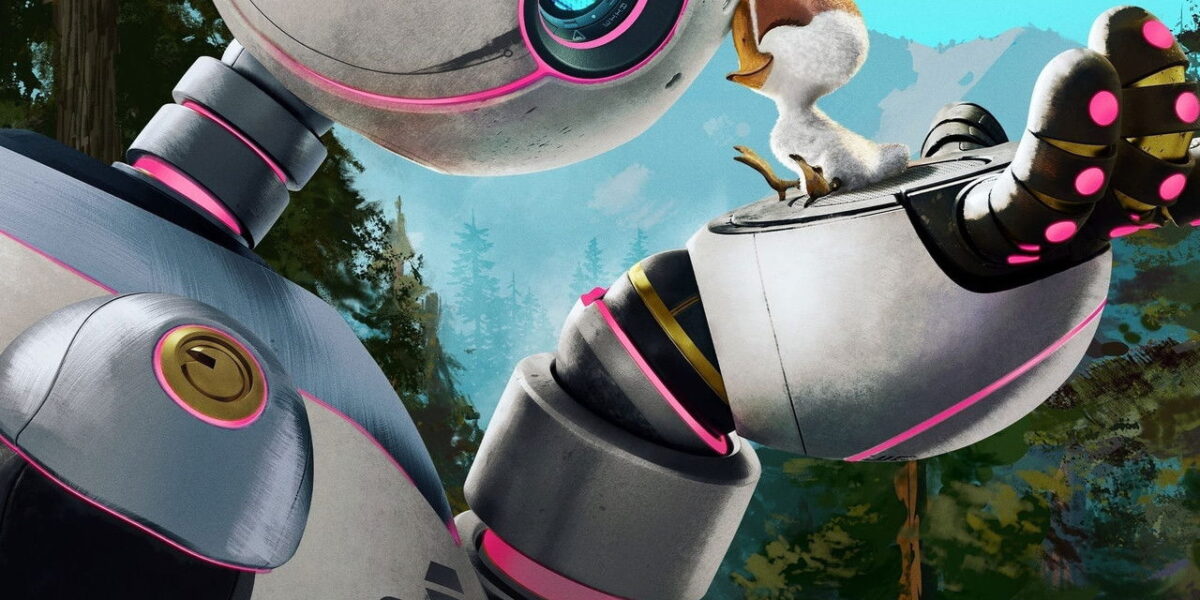
The Wild Robot: Ending Explained — Ultimate Breakdown
Few animated films in recent memory have dared to ask such quietly devastating questions about identity, love, and sacrifice. The Wild Robot arrives in 2024 as something genuinely rare — a film that wears its emotional intelligence like armor, using the vessel of a stranded robot to explore what it truly means to belong somewhere, to someone, and ultimately to yourself. What happens in its final act demands careful unpacking.
The Wild Robot: What happens at the end
In the film’s closing movement, Roz — battered, partially dismantled, and hunted by RECO robots sent by her manufacturer — makes a devastating choice. Rather than flee with Brightbill and the island animals, she turns to face the attacking machines head-on, buying time for everyone she loves to escape. She is captured, deactivated, and dragged back to the factory from which her model originates, seemingly erasing everything she has become through lived experience and unconditional love.
Yet the film refuses to end on annihilation. Brightbill, now grown and returned from migration, leads a rescue. Roz is recovered, but she wakes fundamentally changed — her memory partially wiped, her personality reset toward factory defaults. The island animals and her son must reintroduce themselves to her, and in that heartbreaking moment of reacquaintance, the film poses its most brutal and beautiful question: is identity stored in memory, or does it live somewhere deeper?
The deeper meaning
The ending functions as a profound metaphor for parenthood’s ultimate paradox — the act of loving something so completely that you erase yourself in the process. Roz‘s sacrifice mirrors every parent who has surrendered personal ambition, safety, or selfhood for a child’s survival. That she loses her memory but not her essential warmth suggests Chris Sanders believes identity is not merely data — it is something closer to the soul, encoded not in circuits but in chosen behavior repeated until it becomes instinct.
Sanders deliberately frames Roz‘s reawakening as a kind of rebirth rather than a tragedy. The director’s intention is unmistakable: nature, in all its brutal indifference, ultimately yields to the stubborn persistence of love. By placing this conclusion within an explicitly science fiction framework — robots, factories, corporate control — the film critiques the reduction of living beings to their utility, arguing instead that consciousness finds meaning only through connection and sacrifice freely given.
Hidden details & easter eggs
Attentive viewers will notice that the visual language surrounding Roz‘s partial reset mirrors the film’s very opening — her eyes flicker with the same cold blue light seen when she first activated on the island shore. This chromatic callback is no accident; it is a precise visual rhyme, inviting us to recognize that her second awakening parallels her first birth, but this time she is received by a family rather than an indifferent wilderness. The animators also embed subtle seasonal cues — the trees are in early spring bloom, reinforcing themes of cyclical renewal.
Connections to the rest of the film
The ending’s emotional power depends entirely on a web of foreshadowing laid with extraordinary patience throughout the film. Early scenes show Roz studying animal behavior, mimicking it, desperately trying to compute what cannot be computed — love. That struggle finds its resolution in the finale, where she stops computing entirely and simply acts. Brightbill‘s initial rejection of her, and his eventual acceptance, directly anticipates the closing reintroduction scene, where the emotional roles are quietly, beautifully reversed.
Fan theories
One compelling theory suggests that Roz‘s memory was never fully wiped — that the factory reset was incomplete precisely because her emotional programming had rewritten itself at a hardware level, beyond the reach of a standard reset. Evidence includes her subtle physical gestures toward Brightbill before he formally reintroduces himself. A counterargument holds that these gestures represent residual motor memory rather than emotional recall — a meaningful distinction the film intentionally leaves unresolved. A third reading proposes that the ending is entirely subjective, filtered through Brightbill‘s hopeful perception rather than objective reality. You can explore cast and production details on IMDB.
FAQ
Does Roz survive the ending of The Wild Robot?
Roz survives physically but is partially reset by the factory. She wakes with altered memories, though the film implies her core emotional identity persists beneath the reset.
Does Brightbill remember Roz after her reset?
Yes — Brightbill remembers everything. He leads her rescue and gently reintroduces himself and the island animals to her after she reawakens with partial memory loss.
What does the ending symbolize thematically?
The ending is a metaphor for parental self-sacrifice — the idea that a parent can give so much of themselves that they lose their own identity, yet love finds a way to persist regardless.
Is Roz’s memory really gone, or partially intact?
The film deliberately leaves this ambiguous. Certain gestures suggest residual emotional memory, but whether this is genuine recall or motor instinct is never explicitly confirmed by the narrative.
What is the tagline “Discover your true nature” referring to?
The tagline refers to Roz‘s journey from programmed machine to conscious being shaped by love and choice — suggesting that true nature is not given at creation but earned through lived experience and sacrifice.